10 April 2013

There Are More Fountains than I Thought

Sometimes perspective helps.

A relative for whom I was searching was enumerated as Fountain in the 1850 U.S. Census. His place of birth was born in Germany.

To give myself a little perspective, I performed a few searches in the 1860 U. S. Census at Ancestry.com. I really should have searched the 1850, but the commentary is still valid and I gained the perspective I wanted about how common the name was--or wasn't.

It is easy to see from the number of individuals with various first names, that Fountain was fairly unusual in 1860.  I was fairly certain the name was not all that common, but sometimes analysis shows that assumptions are incorrect.The first names chosen for this informal analysis were done at random. There was no statistical method to this little exercise.


First name
Matches in 1860 US Census Ancestry.com database
John
1,523,058
Mary
1,905,790
Thomas
343,857
George
519, 179
Samuel
209,527
Elizabeth
593, 181
Sarah
803,097
William
820,962
Hannah
158,625
Anna
189,644
Fountain
752

In 1860, there were only two Fountains born in Germany. Based upon that, I concluded that "Fountain" was a very rare German first name or could have been an Anglicization, a spelling error, or a transcription error. Based upon this brief analysis, I concluded that the 1850 census reference to a German native named "Fountain" was probably incorrect. 

There may be more clues in  Ancestry.com than just first and last names.

Can A Picture Prejudice the Jury?

An Indiana judge ruled in 1905 that the publication of an artist's sketch of an adult defendant in an ongoing court case could not be published. Part of the reasoning stemmed from the fact that the case had received a significant amount of coverage in the local newspaper before the trial.

On 10 January 1905, Judge Rasch approved a restraining order forbidding the Evansville Courier and Press from publishing a likeness of Gustave Trautvetter.

Date: Wednesday, January 11, 1905  


Paper: Evansville Courier and Press (Evansville, IN)

from  Genealogybank.com

The judge's order:

Date: Wednesday, January 11, 1905  


Paper: Evansville Courier and Press (Evansville, IN) 

from  Genealogybank.com

Genealogy note: There is always the chance that this order was transcribed incorrectly and, if this were a case I was researching the newspaper account would not substitute for the actual court records. Note that the order is supposedly dated January of 1904 according to the paper. Was that the newspaper's error or the clerk's?

The artist's self-portrait sufficed.


The Evansville Courier and Press printed instead this sketch the artist made of himself with his hands tied behind his back and his sketch book tied shut:

Date: Wednesday, January 11, 1905  


Paper: Evansville Courier and Press (Evansville, IN)

from  Genealogybank.com


The argument made by Trautvetter's lawyers was essentially that Trautvetter had already received enough notoriety regarding the case and that the picture would only add to that and that it would unduly influence the jury. Trautvetter was accused of assaulting a 12-year old child that was living with him and his wife. 

The paper was allowed to print the picture on 14 January 1905 because the jury, deadlocked by one juror, declared they could not reach a verdict and the judge ordered a new trial.

This is the picture that caused all the fuss. Trautvetter and his wife are shown in the foreground in the picture below.

Date: Saturday, January 14, 1905  


Paper: Evansville Courier and Press (Evansville, IN) from  Genealogybank.com 


How prejudicial is the picture? Only one juror in the trial that ended on 13 January 1905 thought Trautvetter was guilty.

We'll have an update on the actual result second trial. My interest in Gustave is extremely peripheral as he is not a known member of my Trautvetter family and I only came across this reference on Genealogybank.com while searching for references to my own family.

Arriving in 1817 from Maryland or Virginia

The problem with looking in just one book is that one book can always be wrong--completely or partially. 

Two histories of Coshocton County, Ohio, mention my ancestor Thomas Rampley (he is actually referred to as Thomas "Ramphey" in both publications making one wonder if there was not a certain amount of copying going on). Both agree that Thomas arrived in 1817-- but they differ in the details.


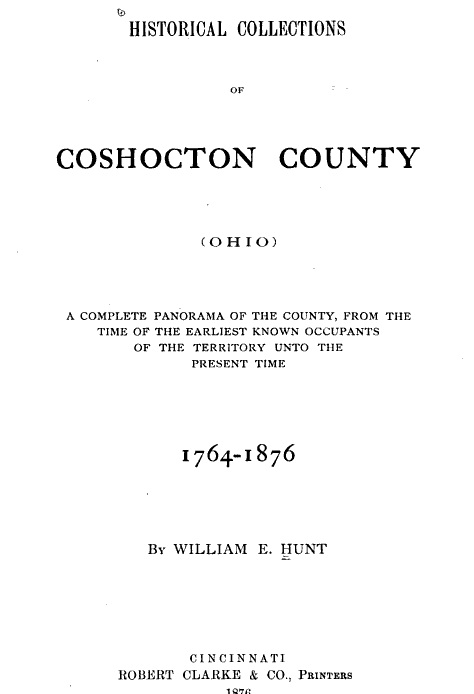
The 1876 reference, shown above, indicates that Rampley came with John Demoss and Crispin Tredaway and their respective families to Coshocton County's Jackson Township in the fall of 1817. Demoss and Rampley were brothers-in-law. Rampley did make an initial payment on federal property in November of 1817 when he is styled as "of Coshocton County, Ohio." The men mentioned above were from Harford County, but just because there are some facts in this reference that are correct does not mean that other facts are necessarily on the mark.

An 1881 history also mentions Thomas Rampley.


The 1881 history, shown above, mentions Demoss and Rampley as early Jackson Township settlers as did the earlier reference. It indicates they arrived in the same year as did the other publication, but here it is indicated they were from Virginia instead of Maryland and Tredaway (actually Treadway) is not mentioned.

Of course, it possible that the Maryland families travelled through Virginia to get from Maryland to Ohio. Geographic realities cannot be ignored and it may be that the reference is technically not incorrect.

By the time these county histories were published, most of the Rampley family had left Ohio for points west. It could also be that information about them came from people "who used to remember them." Second or third hand information is always suspect. And, we don't know who provided information for any of these histories.

Which is why we should obtain references from as many as we can, keeping in mind that any one publication can be wrong.

09 April 2013

German Script--Funeral Text Question

The image below comes from the funeral section of the church register of the Immanuel Lutheran Church, near Basco, Hancock County, Illinois, page 334-335.

This is the section of the entry that apparently mentions the Bible text on which the funeral was based. The heading has been included along with the two entries for the Jans Janssen funeral (part of the next entry is shown as well).

I know what the verses are--from First Timothy and Galatians. My question is what is the abbreviation in front of the verse references?


The second text is also referenced on the tombstone:

New On FamilySearch

New (or updated) on FamilySearch since our last update:

Doubling the Letter With a Line

Ever encountered lines over letters in a transcription or ledger? 

Remember that they mean the letter was doubled as with these names from a church register in rural Nebraska.

The problem is that sometimes when these names are transcribed, they are entered into databases as either Johana or Johan instead of Johanna or Johann.


08 April 2013

Sophia Driesbach

I'll start this off by admitting that the research here is incomplete. 

Sophia (Dirks) Dreisbach died in January of 1914 in Coatsburg, Adams County, Illinois, The obituary printed in the Quincy, Illinois, newspaper a few days later mentions her husband, John Dreisbach.


The Lutheran pastor at the Coatsburg, Illinois,  Lutheran Church was a little more specific about the relationship between the "Driesbacks." While he has Sophia's name slightly incorrect, he indicates that she "died childless and forsacken [sic] by husband."


The Quincy, Illinois, newspaper in March of 1914 indicated that W. P. Simons was appointed executor of Sophia's estate. I'm not precisely certain who he is at this point, but I believe he lived near the Dirks family in rural Coatsburg. 

While this image is out of chronological order, it may explain why I am having difficulty finding the Driesbachs in the 1910 census--as of 1908 they were living in Texas when Sophia returns to Coatsburg to visit her parents and siblings. It only indicates that the Driesbachs had lived in Texas "for some time." 


The Driesbachs were married in Adams County, Illinois, at the Lutheran Church in Coatsburg, in 1894. In 1900, they are living in Bear Creek Township, Hancock County, Illinois-the county directly to the north of Adams.

Why they were there is pretty clear, at least to me. A few households down on the census enumeration is the family of Frank and Anna Goldenstein. Anna was Sophia Driesbach's sister.

The Goldensteins were living on a farm they owned and had lived there since approximately 1889 when they returned to Illinois from Nebraska. The Driesbachs were living on a rented farm. Given that the Goldensteins were already there, it seems possible that Goldenstein might have become aware of the rented farm and was the "connection" that brought the Driesbachs to Bear Creek Township. How long they remained there is not known.


Going Forward

My next plan of attack is to obtain the estate records of Sophia Driesbach. Since there was an executor to her will, there might be some mention of her husband--at least a place to where a notice was sent. An additional fly in the ointment is that Sophia's father died in 1913 and if his estate was not settled upon her death she would have been his heir. An additional look at his estate records may be in order as well as there may be details about the Driesbachs mentioned in Sophia's father's probate as well.

Citation reminder: We are a strong believer in citing genealogical source material in the spirit of Evidence Explained. However, we choose not to include properly formatted citations in these blog posts. There's always enough information in the post to create a citation and full citations are included in my how-to newsletter Casefile Clues. 

Shades of Gray and Why We Cite the Site

Most of the National Archives microfilm has been digitized by one of the major genealogical database providers, either Ancestry.com, Fold3.com, Familysearch, Archive.org, among others. When one cites United States National Archives microfilm in the spirit of Evidence Explained, the National Archives and the website where the digital image was obtained is a part of that citation. 

It may seem like it, but website is not included in the citation just to make busy work or create longer citations to make the researcher appear to have done more work. It is because digital images are not created equally. It suggested the date of access be included as the images could be improved after they are initially made and published online.


NARA Microfilm publication M1372, Roll 122 - 01 Mar 1864-30 Apr 1864; digital image, published in  Ancestry.com s "Passport Applications, 1795-1905," 8 April 2013.


NARA Microfilm publication M1372, Roll 122 - 01 Mar 1864-30 Apr 1864; digital image, published on   Fold3.com , 8 April 2013.


Citation reminder: We are a strong believer in citing genealogical source material in the spirit of Evidence Explained. However, we choose not to include properly formatted citations in these blog posts. There's always enough information in the post to create a citation and full citations are included in my how-to newsletter Casefile Clues. 

A Thunder-Gust Mill

One learns new terminology on a regular basis. An 1876 history of Coshocton County, Ohio, references a mill in Jackson Township that was referred to as a "thunder gust" mill. 


The reason it was called a "thunder-gust" mill is because it only ran with full force after a heavy shower. An interesting little tidbit. I have several ancestors who owned mills (in Maryland and Virginia) but do not believe they were ever referred to as a "thunder-gust" mill. Just one little reminder to always search GoogleBooks or  Genealogybank.com for references to phrases that don't make sense or seem to have fallen out of use. There are other sites as well that may contain printed references to terms that are now obscure.

Citation reminder: We are a strong believer in citing genealogical source material in the spirit of Evidence Explained. However, we choose not to include properly formatted citations in these blog posts. There's always enough information in the post to create a citation and full citations are included in my how-to newsletter Casefile Clues. 

06 April 2013

Twelve Years to Purchase Federal Land

It took twelve years for the federal land purchase of Thomas Rampley in Coshocton County, Ohio, to be complete. This was partially due to this federal purchase being made on credit and also because Rampley died before the purchase could be complete.

This image is part of the final certificate that was issued to James Shores who actually completed the Rampley purchase in what is now Coshocton County, Ohio's Jackson Township. The complete credit under file contains documentation of the claim.

Federal land records are an underutilized resource. The land patents on the Bureau of Land Management website are only the tip of the iceberg. The documentation to prove the claim is in the records of the National Archives. Sales like this one typically have little information--unless there is a death during the process.

I usually don't obtain copies of the cash land sales myself--unless there is something out of the ordinary about the claim, or I'm simply desperate for information on the person.

05 April 2013

Interesting Way To Phrase It In the 1880 Census

Census takers amuse me with their occasional "take" on instructions. 

Readers who are familiar with the pre-printed headings on the 1880 census will hopefully realize why the two items that are marked in green are someone ironic. 


I'll let those who are inclined post comments and later I'll post the answer if no one figures it out.

An Open Letter to the ELCA Archives

To the archivist:

I am grateful that greater access to the microfilmed copies of Evangelical Church in America [ELCA] church records has been made through the ELCA's agreement with Archives.com.

As a professional genealogist and a descendant of many immigrant Lutheran ancestors to the United States, I do have concerns with how these records are being made available to the public. I realize that these concerns may not violate the terms of any agreement between Archives.com and the ELCA, but they are concerns that I feel have not been adequately addressed.

It is not possible on the Archives.com website to "browse the records." One has to search by specific name and, if the name was difficult to read or transcribed incorrectly, searching is difficult. Many early American Lutherans did not speak English as their native language and many pastors of denominations that were predecessors of the ELCA were not native English speakers or writers. Being forced to think what the handwriting looked like and how it might have been read makes searching difficult.

It is not possible on the Archives.com website to determine what records are available for what churches or what time periods those records cover. If I cannot find a record for a relative born in 1893, I do not know if the records have a gap in coverage or if I am simply not searching for the name in the "right way."

I realize that some of these issues may have stemmed from the original microfilming, but the ability to "browse by roll" of film would go a long way to alleviate these issues [note-this sentence was not in my original letter to the ELCA archivist]

The inability to perform specific wildcard searches is another hindrance as well. If I am incorrect and these features are buried somewhere within the site, I would appreciate having that pointed out to me.

With ancestral families who attended several Lutheran churches in Illinois and Nebraska and as a member of an ELCA congregation myself, I was excited to hear about the release of these records. As a professional genealogist and one who wished to use these records, I am disappointed in the way that they have been made available to the public.

Michael John Neill

-----------------------------------------------
I encourage anyone else who may be frustrated by these records to visit the ELCA Archives page at: http://www.elca.org/Who-We-Are/History/ELCA-Archives.aspx and express your concerns. I have no problem with paying for access--that's not the issue.


Being Frank about Dwelling and Family ID Numbers in Citations

This 1910 census image for two families living within the same dwelling makes an excellent point about why 1910 census (and other years) citations should include the dwelling number and the family number. Sometimes more than one family is living in the same dewlling.

There are two families living at 110 W 112th Place in Chicago, Illinois, in 1910--the family of Frank Vanderlinden and the family of Thomas Frame. While it may seem unnecessary to include both numbers in the citation, it makes it clear to which household the researcher is referring. In this case, there are no two people with the exact same name in each household, but if relatives have two separate households within the same dwelling, there could be a repetition of names.

Of course, three of the individuals in the household at 110 W 112th Place had the first name of Frank. Here are citations created for the first Frank and the last Frank.

Frank Vanderlinden:

1910 U. S. Census, Cook County, Illinois, population schedule, City of Chicago, Ward 33 (part of), enumeration district (ED) 33, dwelling 110, family 272, Frank Vanderlinden; digital image, Ancestry.com, (http://www.ancestry.com : accessed 5 April 2013); citing NARA microfilm publication T624, roll. 280.

Frank Frame:

1910 U. S. Census, Cook County, Illinois, population schedule, City of Chicago, Ward 33 (part of), enumeration district (ED) 33, dwelling 110, family 273, Frank Frame; digital image, Ancestry.com, (http://www.ancestry.com : accessed 5 April 2013); citing NARA microfilm publication T624, roll. 280.

From a genealogical standpoint, it would have been better if they had viewed themselves as one family--then all relationships would have been given with respect to Frank Vanderlinden--and the Frames would have been clearly identified as his father-in-law, mother-in-law, sister-in-law, and brother-in-law. But one does not always get that lucky.

Citation reminder: We are a strong believer in citing genealogical source material in the spirit of Evidence Explained. However, we choose not to include properly formatted citations in these blog posts. There's always enough information in the post to create a citation and full citations are included in my how-to newsletter Casefile Clues. 

04 April 2013

Confirmation Records of My Great-Grandparents

I've been playing a little more with the scanned images of church records from the Evangelical Lutheran Church in America which are on the Archives.com website. With a little work, I discovered the confirmation records of my great-grandparents at the Immanuel Lutheran Church in Basco, Hancock County, Illinois. 

I can't determine if the actual baptismal records from the church are on Archives.com as their interface does not allow for browsing. But at this point, indexed access is better than nothing.


My great-grandfather Ufkes is the second entry on this list--Friederick Janssen Ufkes, son of J. Ufkes u. frau. All the parents were listed as the father and the wife. 
Confirmation record from Immanuel Lutheran Church, 4 April 1909, Basco, Hancock County, Illinois; digital image on Archives.com. 
 My great-grandmother Ufkes is listed a year later--Trientje Maria Janssen.
Confirmation record from Immanuel Lutheran Church,20 March 1910, Basco, Hancock County, Illinois; digital image on Archives.com.
I'm hoping to make a few more discoveries in these records. Some churches would record the confirmation verses in these records. Apparently Pastor Geissler didn't do that.

My great-grandmother Habben is probably in these records as well. However her name did not come up in the index. Finding her, with the inability to browse, may be a little bit of a trick.

Christianna's Neighbors in 1830

1830 U S Census, Jackson Township,
Coshocton County, Ohio;
digital image,  Ancestry.com 
I have always liked this 1830 census entry from Coshocton County Ohio's Jackson Township.

The ancestor is Christianna Rampley. The man listed above her (James Shores) is her son-in-law. The man listed above him in Crispin Treadway who came with the Rampleys to Ohio in 1817. The man two names above that is John "DayMoss" (De Moss), Christianna's brother and another who came with the Rampleys to Ohio in 1817.

Neighboring names are more than just names that appear on the same piece of paper as your ancestor's name.

Citation reminder: We are a strong believer in citing genealogical source material in the spirit of Evidence Explained. However, we choose not to include properly formatted citations in these blog posts. There's always enough information in the post to create a citation and full citations are included in my how-to newsletter Casefile Clues. 

03 April 2013

Two More Concerns About the ELCA Records at Archives.com

This will be short and hopefully I am overlooking something.

At this point, in the ELCA records at the Archives.com website, I am unable to:

  • easily determine what churches are in the database
  • determine what time period the records actually cover
From the perspective of conducting sound genealogical research, this makes effective use of the records difficult, makes the adequate citing of research problematic, and does not easily allow me to know whom I should really expect from the database.

There's another word that applies, but I'll leave that up to the reader to discern.

Don't get me wrong---I love having these images available and the price is not bad. But the way in which these records are distributed by Archives.com to the user needs to be modified. My previous post can be viewed here. 

Database Entries May Not Always be Correct-Flanagan is Not Golden

This is the screen shot for my search for Anna Goldenstein in the at Archives.org.

The location of the church indicates it is in Flanagan, Illinois. The actual location should be Golden, Illinois. In viewing just the entries on that page, I recognized enough Golden area names to know it was not a church in Flanagan. Of course seeing great-grandma's entry sealed the deal as it matched what I knew about her already--that she died in Golden, Illinois, in 1932.

So for now, this image is known to have come from a Lutheran Church in Golden, Illinois. And Golden had more than one Lutheran church--never assume a small town will only have one church in any given denomination.


The number of survivors are listed as well as the Bible texts upon which the funeral sermon was based.

But I'll have to doublecheck what church the Goldensteins attended before I make this citation.

ELCA Records at Archives.com and Some Concerns

Archives.com recently announced the release of digital versions of microfilmed records of church records in the Archives of the Evangelical Church in America (ELCA). Until now, most of us have had to rely on actual use of the microfilm to view these records.

For those of us who had ancestors that were Lutheran, this is a huge set of records. However, there are some challenges to the way these images are currently presented to the public.

At this point, these records are only searchable by name--you cannot browse the records of a specific church or view page by page. This is a serious limitation--particularly if the name for which you are looking was difficult to read in the original records or if the researcher doesn't know "all the names" already. Many of these records were in German or Swedish and there are times where that writing is difficult to read and transcribe.

The other concern I have is how the congregation is named in these records.

This is the screen shot for the "results" I obtained when searching for my grandfather:

The name of the church does not appear to be the name of the actual church--it appears to be the name of the "denomination" of which the congregation was a member when the records were microfilmed. Many Lutheran churches were members of the former America Lutheran Church. This church is actually the Immanuel Lutheran Church near Basco, Hancock County, Illinois. The database indicates this congregation was in Carthage, Illinois--which it was not. To the best of my knowledge this church was never called the "American Lutheran" church (this church was actually having services in German in 1917). This generalization of church name appears to be the case with other church records in this database. This is a serious difficulty with this database and one that I hope is rectified. If the user is already aware of where the person was a church member and is simply confirming information--then this is not a problem.

The scans are nice as shown in this enlargement from my grandfather's baptismal entry from 1917 in the Immanuel Lutheran Church near Basco (this is only part of the entry):

A few other finds


I did find some really neat entries in this set of images--mainly for people I already had information on but for whom I had never looked at the church records.

My great-grandmother's 1882 baptism from Dawson County, Nebraska:

American Lutheran Church,[sic] Gothenburg, Nebraska, 1882 baptisms, Tjode Anna Goldenstein: digital image on Archives.com. 

The death entry for my ancestor Bernhard Dirks from 1913 in the Lutheran church records from Coatsburg, Illinois.

Bernard and his daughter Anke both died in 1913--interesting that his entry is in German and hers is in English.

In Summary

It is great that Archives.com has released these records to their subscribers. The indexing appears to be pretty good from my not so random sampling. But my wishes for this database are:

  • Specific name of the congregation as a part of the "results"
  • Ability to browse the records. Having to search by typing name only is inefficient.

Users who already have a good idea of for whom they are looking will make finds in this database. I'm hoping that by the time I've exhausted all my searches, the browse feature is activated. It'll take me a little while as over half my ancestry was Lutheran at some point in time.

FamilySearch Update

The following FamilySearch database is showing as "updated" since our last posting:

United States, Civil War Widows and Other Dependents Pension Files

An Easy Way To Cite Images

Digital images are my preferred way to reproduce records for a variety of reasons. The ability to later create documentation though is crucial when reproducing any type of record. For records from the National Archives, which require a little bit more in the way of detail than local courthouse records, I find cards of this type helpful. A scan of the card is included with the set of digital images made from the record.

Sometimes when researching onsite, if I've taken notes on paper about what I located, how I searched, etc. then I also include a picture of those notes along with my actual images of the records. That way everything is in the same place and I don't forget.

Citation matters--make it as easy on yourself as possible.

Citation reminder: We are a strong believer in citing genealogical source material in the spirit of Evidence Explained. However, we choose not to include properly formatted citations in these blog posts. There's always enough information in the post to create a citation and full citations are included in my how-to newsletter Casefile Clues. 

02 April 2013

Was It Really Even a Deed?

My earlier blog post mentioned two "deeds" that were located in the "Complete 'Credit Under' Land Entry of James Shores, assignee of Thomas J. Rampley" of Coshocton County, Ohio."

Here is my question:

Should they even be called "deeds?" After all the claim process to the land in question had not been completed on 21 April 1829--in fact these documents were part of the documentation submitted in support of Thomas J. Rampley's patent being issued to James Shores. 

Just what should these documents be called?  Maybe transfers or assignments are better words. But now that I think about it, maybe "deed" is not how I should have been referring to these documents. 

Judy G. Russell answered this question in the Legal Genealogist on 4 April 2013. 


A Straw Man in a Credit Under File

It is all about how things are ordered and how people are described.

There are two deeds in the "Complete 'Credit Under' Land Entry of James Shores, assignee of Thomas J. Rampley" of Coshocton County, Ohio. Both are dated 21 April 1829. One transfers interest in the patent from Thomas Tipton to James Shores. The other transfers title in the patent from James Shores, Administrator of the Estate of Thomas J. Rampley, deceased, to Thomas Tipton. Both list the same property (part of section 5 in what is now Jackson Township, Coshocton County, Ohio) that is described in Thomas J. Rampley's "Complete 'Credit Under' Land Entry." Copies of both deeds are contained in the records of the complete claim file at the National Archives.


Part of the patent to James Shores obtained on the Bureau of Land Management website.
Why are there two deeds that are seemingly parallel?

There's a reason and the reason is that the deeds are not parallel. They also need to be viewed in the proper order. Both are dated the same date, but one was executed first--the one from James Shores.

The thing is, it was not James Shores who really executed the deed. It was James Shores in his capacity as administrator of the estate of Thomas J. Rampley who deeded the equitable interest in the land claim to Thomas Tipton. Then, Tipton immediately deeded that interest to James Shores in his own right. This was not done to confuse researchers nearly 200 years later.
part of the 21 April 1829 deed from Thomas Tipton to James Shores, obtained in the "Completed "credit under" Land Entry" of  James Shores, assignee of Thomas J. Rampley; National Archives

It was done to keep the title clean and appease the General Land Office. It would have looked odd if Thomas Shores as administrator had deeded the land to himself, particularly since there were heirs of Thomas Rampley who had an interest in the property upon his death. And there were heirs: Thomas' widow, Christianna, and several children--including the wife of James Shores.

Tipton was what is referred to as a "straw man." The intent was never to have him actually own the property in question. The deed to him and the deed from him served to clearly give Shores title and document the payment.

The order of the deeds matters--the deed from Shores was first. The description of Shores matters as well--words like "administrator" are not thrown around in documents willy-nilly.


Citation reminder: We are a strong believer in citing genealogical source material in the spirit of Evidence Explained. However, we choose not to include properly formatted citations in these blog posts. There's always enough information in the post to create a citation and full citations are included in my how-to newsletter Casefile Clues. 

FamilySearch Updates 1895 Iowa State Census

New since our last posting:

FamilySearch has posted an index to the 1895 Iowa State Census. The images are there too, but as of this writing they are not linked to index entries. You can browse them from the search page though.

Ancestry.com Adds Early Tennessee Tax Records 1783-1895

Ancestry.com has added "Tennessee, Early Tax List Records, 1783-1895" to their list of available collections.

This image comes for the collection--Davidson County, 1811:


The numbers appear to be a running headcount, not any number associated with people, livestock, etc. within the household. It pays to look at things in context.

This entry makes the point about the importance of looking at neighbors. Absalom Hooper Junr. and Senr. are on this screen shot--remember that "Junr." and "Senr." may or may not designate father and son. There are other Hoopers on this portion of the list, including Nimrod. There is also an Aquilla Jones whose wife was a daughter of Absalom Hooper--of course that is not indicated here either, but it makes a comment about the necessity of paying attention to "nearby" names.

A few warnings about these images at Ancestry.com:

  • Check alternate spellings--some of these records are difficult to transcribe.
  • Manually search pages for areas where you think your person lived.
  • Determine just what years and counties have been posted. The database may be incomplete for your area of interest. 
  • Do not assume that this collection is complete for every location during the years that are listed of 1783-1895. That cannot be overemphasized.
  • And not all counties may even have extant records for the time period of interest. 
Neat stuff, but use responsibly.