14 June 2014

"In the Devil's Snare" Mentions An Ancestor

I'm reading In the Devil's Snare: The Salem Witchcraft Crisis of 1692 after having discovered that an ancestor of mine, Capt. John Floyd, was accused of being a witch during the Salem witch trials.

It's not often that I actually find an ancestor discussed in a historical work, let alone one published by a major publisher. It does help that the witch trials are one of the most written about events in American history. Norton actually discusses Floyd's military career and how it potentially relates to the charges of witchcraft brought against him. Norton includes citations to several references in her discussion of Floyd.

Sometimes those additional references are the best thing about finding an ancestor mentioned in a published work. I discovered that Floyd was mentioned in several printed references by searching for him on Google Books. This search was conducted before I even discovered he was involved in the trials.

Norton's historical background will enhance my own research during this time period.

And she even discusses the importance of putting things in a chronology--something genealogists should be doing regularly anyway.

12 June 2014

pre-1850 Census Webinar

  • Creating Families from Pre-1850 Census Records --This presentation discusses how to analyze pre-1850 census records in order to determine the family structure that is suggested by those records. Enumerations for one household between 1810 and 1840 are analyzed in order to determine the number of children, ranges on their years of birth, and ranges on years of birth for the oldest male and oldest female in the household. Priced at $8.50 for immediate download. Includes recording and PDF of handout. 

The Same Person Writing in 1830 and 1847?


The image in this blog post is a marriage bond signed by a Thomas Brown and Alexander Riley in 1830 in Bourbon County, Kentucky, and was made from a digital image of the bond which appeared on FamilySearch


Yesterday's post included an 1847 marriage bond from Mercer County, Kentucky, signed by John Lake and a Thomas Brown.

The signatures from both bonds have been contrasted in the image shown below:


Are the two signatures the same? It is important to note that any person's signature can easily change over seventeen years and the type of pen being used and the writing surface can impact how different two signatures look--even when it is known that they are from the same person. The "T" in "Thomas" is different. However, the rest of the signatures are very similar (part of the last name is difficult to read in the 1830 signature).

If Thomas Brown was not such a common name this would not quite be the problem that it is.

11 June 2014

A Lake Bond

This marriage bond was taken out in Mercer County, Kentucky in 1847 by John Lake and Thomas Brown in preparation for the marriage of John Lake and Charlotte Brown. The image used in this blog post was made from a digital image of the bond that was located on FamilySearch.
John Lake is signing for himself. Thomas Brown is signing for Charlotte. There's no direct statement or indirect information here regarding the relationship between Thomas Brown and Charlotte Brown. The fact that he has the same last name as Charlotte and that one party on a bond usually signed for the groom and the other party usually signed for the bride suggests a relationship. Thomas could have easily been Charlotte's father, uncle, or brother. The law wasn't concerned about the specific relationship between the Browns. The law was concerned that he could vouch for Charlotte's age and eligibility to marry.

The best plan of attack at this point is to review 1840 and 1850 census enumerations for the Lakes and Browns in Mercer County, Missouri, for John Lake and Thomas Brown. It is worth noting that there's no guarantee that either man is in the county in either of those years.

09 June 2014

What Ancestry.com has on the World's Oldest Man--Who Died Today at 111

CNN is reporting that the world's oldest man, Alexander Imich, died today in New York City at the age of 111.  A quick search indicates he did arrive in the United States in 1951 as stated in the article. The earliest reference to Imich  that was easily located is from a 1951 card and passenger manifest.

Ancestry.com includes several references to Imich in their set of databases, including a copy of his "displaced refugee card:"

A Soundex card referencing his naturalization:

A passenger manifest entry in 1951 for he and his wife, Wela.

All these references are consistent with a 1903 date of birth and the age listed for him on the CNN website. Two of the references provide the same date of birth--4 February 1903. CNN indicated on their news item that Imich's age had been verified, but they do not mention what contemporary documents were used.

Most genealogists would consider these sources as containing secondary information on Imich's birth--which does not mean the date is not accurate. Referring to these references to his date of birth as secondary only means that it was not provided by someone who had first hand knowledge of the event. It is possible that some primary record of Imich's birth exists, but that's not referenced in the article. I am wondering if these records were used to validate his age or if other records might have been located--ones that were more contemporary to his birth than these. My interest is only academic since I have no Polish ancestry of my own I'm probably not going to pursue this any further.

This was an interesting exercise for me in seeing what relatively recent material Ancestry.com has. I'm usually working on things not quite as recent as the 1950s.

Renters in the Paper and References to the Dead

I posted this image on Search Tip of the Day in reference to OCR search concerns, but as I looked at the text of the item I realized that there were at least two other genealogical points which it makes as well.

The item, from the 20 Feb 1916 issue of the Daily Gate City, discusses "moves" taking place on various farms in Hancock County, Illinois' Montebello Township (located along the Mississippi River). Spring was a popular time for renters to migrate from one farm to another, and newspaper accounts in rural weekly papers are probably one of the few places to find references to such moves.

Leases and rental agreements between landowners and tenants were frequently not recorded in any official location and it's possible that some rental agreements were only "sealed" with a handshake and not even a signature. Those with ancestors who were tenant farmers may consider looking in the local "gossip" columns for mentions of their ancestor. Court records may reference the lease if there as a disagreement between the tenant and the landlord that resulted in court action.

Unfortunately those of us with ancestors who were hired men typically won't find them mentioned in newspapers in the way in which some tenants are.

References such as these usually refer to farms by the name of their owner or former owner. By 1916 Adam Trautvetter had been dead for several years, but apparently locals knew the farm by that name. This is another reason that some relatives may appear in newspapers after they are deceased--in this case several years and long after Adam's estate had been settled in the local probate court.


08 June 2014

Leaving the State to Find My Kin

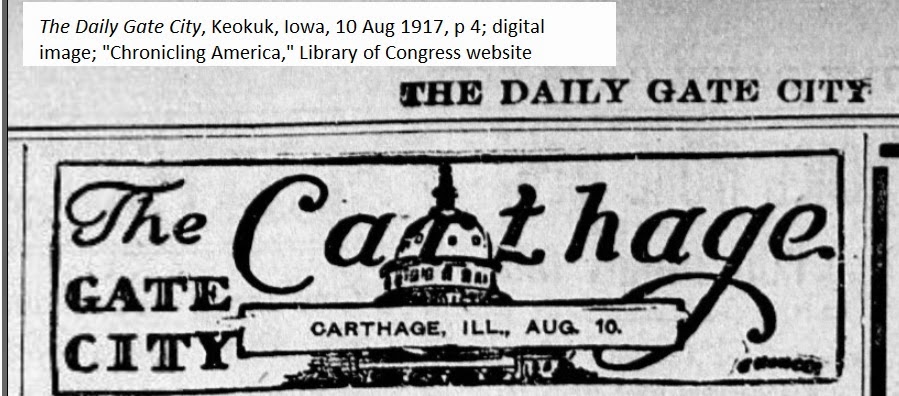
For a time in the early 20th century, the Keokuk, Iowa Daily Gate City had several sections that it called the "fill in the blank" Gate City.The image that is a part of the blog post is from the "Carthage Gate City." 

Fortunately the Chronicling America project at the Library of Congress includes some issues of the Daily Gate City in their collection. The newspaper includes these "gossip sections" for several areas on the Illinois side of the Mississippi River where my family has lived from the late 1840s until the present. And while I wait for the eventual day that those newspapers are digitized, I can search the Keokuk newspapers for mention of my relatives.

Sometimes one does have to leave the state to find one's ancestors.

We'll be posting the occasional item of interest on this blog.

We'll try and avoid posting mentions of which relative brought what dessert to the church social.


07 June 2014

Allen County Library Research Trip 2014

Join me for 3 plus days of research at one of the largest genealogical libraries in the United States, the Allen County Public Library in Ft. Wayne, Indiana, in August of 2014. Additional details are on our web site.

See you there!

The Census Taker Cometh

THE CENSUS TAKER COMETH," by Michael John Neill 

(c) 2014 Michael John Neill--this article originally appeared in the Ancestry Daily News and is used by the author on his blog with permission

It is June 3, 1860. 

Anna Gufferman, who is twelve years old, sees a stranger approaching her small home. He looks reasonably dressed and does not appear to be carrying a weapon. Illinois is not as wild a place as Nebraska where her cousins live, but mother has warned her that one can never be too careful. She shoos her five younger siblings in the house as the man approaches.

He approaches the front yard and calls out for the man or the woman of the house and says he is here to ask questions for something called the "census." Anna is wary of calling for her parents if there is no need. When Father and the boys are in the field, he does not like to be disturbed, not even if Grandfather comes. Mother is down at the creek by herself, having left Anna with the children. The weekly washing is one of the few times Mother does not have several small children underfoot, and Anna is hesitant to bother her if it is not absolutely necessary. Anna decides this "census" does not require her to disturb her parents. She tells the census taker that she is very familiar with the family and the goings on in the household. After all, she is twelve years old and responsible for several 
younger siblings.

The census taker asks Anna several questions, which she frankly thinks are none of his business. He tells her that the government needs to know this information and that it is important it be accurate. Anna does the best she can to answer his questions. He starts by asking her the names of her parents and her siblings.

"It is a good thing my parents are not here," Anna thinks to herself. While her English is rudimentary, it is considerably better than the handful of words her parents have managed to learn. Determined to impress the census man with her knowledge of English, she indicates that her parents are not Hinrich and Anneke Gufferman, but that they are rather Henry and Ann. Her other siblings all have names more German sounding than Anna's. She decides to provide the census taker  with English versions of their names, just as she did with those of her parents.

Anna is not quite certain how old her parents and her siblings are, but the man seems to insist on knowing their age precisely. Their christening names and dates of birth would be in the family bible, but Mother would fly into an absolute rage if Anna got the bible herself and began leafing through it. Deciding it was not worth the risk of her mother catching her in the act, Anna guesses as to the age of her parents. Despite her uncertainty, she speaks clearly and distinctly to convince the census man that she knows the ages precisely. He seems pleased to get the information.

He then asks where her parents were born. Anna knows they were born in Germany and were married there. Those questions are easy. The census man then asks where she and her siblings were born. These questions are not so easy. She cannot remember which of her older brothers were born in Germany and which ones were born in Illinois. She remembers that her parents lived for a while in Ohio before coming to Illinois. And frankly, she is getting tired of all the questions. Consequently she tells the census taker that her two older brothers were born in Germany, the next was born in Ohio and that all the remaining children were born in Illinois.

Anna decides to give hurried answers to the rest of the census man's questions. He has taken time away from her chores and Mother will not be happy if the morning tasks are not done when she returns. Occasionally impatient with Anna's delayed answers, the census man seems pleased when Anna begins answering the questions more quickly. Eager to please and knowing she should return to her chores, Anna speedily answers the remaining questions, paying little concern to the accuracy of her answers. 

It is June 25, 1880.

The census taker arrives at the home of Hinrich and Anneke Gufferman.It is a different place than his fellow enumerator encountered in 1860. Hinrich and Anneke have two children at home, the youngest son who helps his father farm and a daughter who works as a hired girl for a Swedish couple up the road. There is still plenty of work for Anneke to perform around the house, but no longer meeting the needs of twelve children makes her life less harried than it was before.

Anneke invites the census taker into her kitchen and after he indicates some of the information he needs, she goes and gets the family bible, which contains the names and dates of birth for her husband and her children. She opens the bible to the appropriate page and tells the census taker there is the information. The entries are written in Hinrich's bold, clean script and the census taker only has difficulty in reading the name of the youngest daughter Trientje, which he copies down as Fruita. Otherwise the odd-sounding names are easy to read and the census taker simply copies them into his record. 

There are additional questions and Anneke provides the answers as best she can. In Germany, her husband was a day laborer and had moved several times looking for work. When asked where her husband's parents were born she is not certain; Hinrich's mother died when he was a baby and the father had died shortly after their marriage. Anneke told him the parents were born in Germany. Anneke was not 
certain of her father's place of birth, either. He had died before her birth and had been a soldier. Anneke had been named for her father's mother, with a first name that was unusual for the area of Germany where she was from. Thinking her father was Dutch, she told the census taker that her father was born in Holland. But she was not really certain. 

It is June 16, 1900.

The census taker comes to the door of Hinrich Gufferman. It has been a month since his beloved Anneke has died. Hinrich does not know the census taker. He swears at him in German in a booming voice and the enumerator senses that he will get no answers. Gufferman's son Johann lives a few miles up the road, fortunately in the same township. The son had told the census taker that Hinrich was taking the death very badly and was only speaking to a few family members. Johann told the census taker to come back if information was needed on the father. It looked like the enumerator would have to take Johann up on his offer.

Ever wondered why some census entries look like creative accounting? Have you ever thought about what actually transpired when the census taker arrived at your ancestor's home?


(c) 2014 Michael John Neill--this article originally appeared in the Ancestry Daily News and is used by the author on his blog with permission. Any other reproduction or publication is not permitted.

05 June 2014

Marrying Again and Giving My Children My Dower Interest in 1770

Probate records can often contain clues regarding subsequent marriages of surviving spouses.

This refusal of dower by Mary Crown in 1770 of Stowe, Massachusetts is a prime example.

Ephraim Puffer, Probate case packet 18232, Middlesex County, Massachusetts. Dower refusal of Mary Crown to estate of Ephraim Puffer, 9 April 1770.
Ephraim died in 1757 in Stowe, Mass.
Mary mentions that she has a dower interest in the estate of her first husband, Ephraim Puffer. The refusal also references her children (however they not named in this named in this document).

A complete reading of any probate record is always advised. From a genealogical standpoint, records where statements are completely handwritten can contain more extra details than those written on "fill in the blank forms. Reading the handwriting takes some practice.


FamilySearch Updates: Boston Crew Lists and San Antonio Arrivals

The following databases are showing as new or updated on FamilySearch since our last update:

Massachusetts, Boston Crew Lists, 1917-1943

Texas, San Antonio, Alien Arrivals, May 1944-March 1952

Probate Mentions the Deceased Father-in-Law of the Deceased

One never knows what one will find in estate records. Sometimes references may be made to items that one does not typically expect. That's the case with this image from the estate of Ephraim Puffer.

Ephraim Puffer, Probate case packet 18232, Middlesex County, Massachusetts. Report dated 12 April 1770.
Ephraim died in 1757 in Stowe, Mass.
This is part of a distribution report of the estate of Ephraim Puffer of Stowe, Massachusetts. The record shown partially here indicates that it has been found that Jonathan Puffer has been given the full portion from his Grandfather Daby.

The item does not mention anything further about Grandfather "Daby," nor does it indicate any reference to where Grandfather Daby lived before he diedor  any details about his estate. It may be worth my time to start a search for Grandfather Daby by searching for Daby estates in Middlesex County and working my way from there if a reference cannot be located.

The 1770 document indicates that the children of Ephraim are of age--which would have been helpful if that information had not already been known from other records.

Heading Home and Beat the Train Webinar Sale

I'm heading home from Salt Lake from a successful group research trip where I was able even to find some items of my own that I'll be writing about over the next several months. You can read the slavery in New England post here or the three generation deed here.

At the request of some followers, we've reactivated the webinar downloads until my train gets me back home around noon on 6 June. If there was something you missed, now's a good time as the download site is being phased out when my next billing cycle comes around in mid-June.

For those who are big fans of scanning and making digital images, I only made about 15 paper copies the entire week I was at the Family History Library.

If you missed the webinar closeout, or wanted to add one additional presentation to your collection, now's an excellent time.

This page is:
http://rootdig.blogspot.com/2014/06/heading-home-and-beat-train-webinar-sale.html

04 June 2014

Freedmen's Bureau Records: Arkansas

This item is showing as "updated" on FamilySearch since our last update:

Arkansas, Field Offices Records of the Freedmen's Bureau, 1864-1872


Primogeniture and Slaves in New England in 1702

This is a wonderful deed of partition from Suffolk County, Massachusetts in 1702. It was created by the heirs with the intention of "preventing all Future difference that might arise among our Selves, or our Children after us..." That's  a very subtle way of stating it. One always wonders if some squabble precipitated documents of this type or if someone simply decided it was time.

Research in New England can be different from research in other areas of the United States-largely because better records were kept, particularly vital records. Sometimes researchers avoid using land, court, and other records, simply because so many genealogical summaries have been complied and published. These records should never be ignored.

It is even better when one runs across a document such as this one. In 1702 the heirs of John Floyd partitioned his estate amongst themselves.

His widow was to have her "thirds" and the oldest son Hugh (stated as such in the document) was also to have a double share. Both those practices were common during the time period in question. It's too bad that there were not inheritance distinctions among other children so that the complete birth order could have been determined explicitly. Seriously, there is a good chance that the children are listed in order of birth, but there is no requirement that any such specific ordering be used in records of this type

The partition also mentions several slaves owned by Floyd at his death. Most of them are referred to by name and one is even referenced as being the child of two of Floyd's slaves.

This was another little gem I copied while on my trip to the Family History Library. Never ignore original records. Neat little things like this document are often highly summarized in some published genealogies.

FamilySearch Updates: WW1 Draft Cards and Montana Materials

The following databases are showing as updated since our last FamilySearch  posting:

United States World War I Draft Registration Cards, 1917-1918

Montana, Beaverhead County Records, 1862-2009

I'm not certain how many changes have been made, but the website is indicating these have had modifications in the last few days.

Theodore Trautvetter's Disappearance From Start to Finish Part V

[continued]


[Warsaw Bulletin, 24 January 1890, page 4]

Quite a number proceeded to drag the river at a point below where the traces of blood were found but, of course, without success. Those who believe in the mesmeric powers of Dr. Wright were convinced that Troutvetter was murdered on the bridge and his body thrown into the river. There were many others, with no faith is mesmerism, as thus applied, who were satisfied that Troutvetter met with foul play; and if he had, the river offered a convenient repository for the body and the season was opportune for thus shielding the crime for months to come---perhaps forever.


[ to be continued]

03 June 2014

A Deed Confirms in 1752

Sometimes the deeds that don't mention any specific real property are the best ones for a genealogist to find.

This 1752 deed from Massachusetts makes the point very well.

Thomas Sargent and Tabitha his wife are quit claiming their interest in the estate of her father, Samuel Tuttle, of Chelsea, Massachusetts, to her brother John Tuttle, Junr., also of Chelsea. The deed also indicates that Thomas and Tabitha are quit claiming their interest in their grandfather John Tuttle.

The deed does not mention any specific property, but indicates that it covers all real and personal property belonging to Samuel Tuttle or John Tuttle (father of Samuel Tuttle).

These relationships are mentioned in various vital records from the area. The value in this document is that it confirms where certain family members ended up (the Sargents were living in Leicester, located in Worchester County). Vital records often do not "tie" people together in the way that this deed does.

This wonderful record confirmed some identities for me.

02 June 2014

Taking Pictures of My Note

When doing onsite research, tracking sources and process is still necessary.

The problem is that it takes time away from actually obtaining records. That's something most of us do not want to do when at a research facility a distance from home.

I still make quite a few handwritten notes when researching even in this digital age. For me, it is simply faster and easier. The difficulty is that these loose pages can get lost and misfiled before they can be included as a part of the research summaries I make when I get home. That does not save time.

So I started taking pictures of those notes and emailing them to myself with enough keywords in the email text that a search of my email will pull up the desired note if I can't find it. I could also save the digital scans on my phone, a file server on the "cloud," etc. I prefer the email as I can attach the image and include in the text of the email additional commentary that I can type faster than I can write--and my typing is often easier to read than my handwriting.

I'm working on separating out at least two contemporary Rufus Stephens in New York State in the early 18th century. My initial analysis separated out one of those Rufuses. The handwritten chart doesn't include citations, but there is enough detail on these Lewis County, New York, Rufuses that I could easily create complete citations should that be necessary.

The main thing is that I don't lose these notes.


01 June 2014

Finding Grass When I Was Not Looking For It

This was an unintentional find while searching for land records in Adams County, Illinois. Sometimes the accidental finds are the best ones.

While working my way to the "H" section of the grantor index for Adams County, Illinois, I stopped the microfilm at the "G" section to see where I was and an index entry for Bertus Grass literally popped out at me on the page. I wrote down the book and page number and went back to my assigned task. Copying the record would not take much time, but I was not going to get sidetracked.

Deed Dated 19 October 1883,
Adams County, Illinois, Deed Book 100: 619; obtained on microfilm
at Family History Library. 

I knew that my uncle Bertus Grass and his wife Anna G. Grass had lived in Adams County, Illinois, for a while in the 1880s. What I was not aware of was that he owned a mill in Payson--which was the subject of this quit claim deed in 1883.

Going forward, I'll need to determine when Grass acquired the property by searching the grantee indexes for Bertus. There should be an entry as Grass probably acquired the property through a purchase instead of an inheritance as his parents and his in-laws were in Germany.

It is also somewhat unusual that the Grasses were in Payson. The Grasses were one of hundreds of Ostfriesen immigrants to Adams County, Illinois, but the majority of those immigrants settled in the immediate vicinity of Golden. Goes to show that people don't always settle precisely where we think they "should." Grass may have had to settle in a slightly different area as there is only so much mill work to go around.

It always pays to keep your eyes open.

In my notes on Bertus, I'll make a note that this reference was a "stumbleupon" find. That way I don't think I forgot to locate the deed of purchase.


Webinar Issues and Downloads

If you ordered a webinar and had download issues or concerns, please email me at mjnrootdig@gmail.com.

We have "re-opened" the sale page for today (1 June) as one blog announcement regarding the sale went out later than scheduled.

30 May 2014

How Common Are Your Names?

How unusual are your names? I always knew many of my immediate surnames were not overly common, but now I have some evidence--at least when my names are compared to other names in the United States.

Using the database search form at "How Popular is Your Name" on the "Sweetest Sound" on PBS.org, I determined the popularity ranking of the surnames of my four great-grandparents.


  • Neill-3651
  • Rampley-34381
  • Trautvetter-99676
  • Sargent-1190
  • Ufkes-110472
  • Janssen-3100
  • Habben-40720
  • Goldenstein-43095
Of course some unusual names are difficult to research and some common names are easier to research. The frequency of a surname is only one factor in whether or not an ancestor is a research challenge.

Update on a Weight of 999

An earlier post mentioned unusual heights and weights in a database (U.S. World War II Army Enlistment Records, 1938-1946") at Ancestry.com. It turns out that the original data was the problem and the problem is noted on the "more about" page for the database on Ancestry.com.

The data from which the database was created is also discussed on the National Archives website along with a notation that the National Archives does not make the "height and weight" data available on their version of the database.

Theodore J. Hull's 'The World War II Army Enlistment Records File and Access to Archival Databases" (which appeared in the Spring 2006 issue of Prologue available online also), states in part that:

"Over time the enlistment card format changed, and the height and weight or military occupational specialty categories were recorded in the same columns on the original punch cards. Because there is no easy way to distinguish original data recorded on the two forms, NARA chose to drop that data..."
 Based upon this it appears that there is good reason not to include the height and weight data.

Weighing 999 With a Height of 89

A member of the "Genealogy Tip of the Day" group on Facebook located this reference in the "U.S. World War II Army Enlistment Records, 1938-1946," on Ancestry.com for a James L. Dozier that indicated a height of 99 and a weight of 999 as shown below.


Obviously the measurements are not in inches and are not correct. It's possible that a description of this database at the National Archives indicates what these unusual numbers mean. It seems reasonable that they obviously incorrect numbers are some sort of code to indicate something else.

We'll see if we can get the answer and follow up.

[note: it appears that this error may be due to a card read error on the card that was punched to store the data.]


29 May 2014

An Umlaut Problem, Original Data, the "Source," etc.


Part of analyzing sources is getting as close to the original as possible. This "Passenger and Immigration Lists Index, 1500s-1900s" entry in Ancestry.com contains a reference to Wilhelm Metz who arrived in the United States in 1833.

Ancestry.com indicates that the "original data" for this entry is "Filby, P. William, ed. Passenger and Immigration Lists Index, 1500s-1900s. Farmington Hills, MI, USA: Gale Research, 2012."  Searchers have been using Filby's for years, before the information he compiled was ever available in digital format.

While this is the original data for the Ancestry.com database entry, it is not the original source of the informtion contained in this entry. Filby's book indexes an article by Wilhelm Hauth which in turn was probably taken from original records of some sort. 

Because of the number of iterations between the original entry and the image shown in this blog post (which is actually from the Ancestry.com "Passenger and Immigration Lists Index, 1500s-1900s"), it is desireable to obtain the original record if possible.  Genealogists are always advised to "get to the original."

And that's good advice, but it wasn't the problem that actually led to this blog post. It was use of the word "Blaetter" in the Ancestry.com description of the source Filby used to create his index that was the problem.

I searched for "Blaetter Familiengeschichtliche" as a keyword (without quotes) in the card catalog on the FamilySearch website. No luck. It took a little searching and finally I located the entry searching only for Familiengeschichtliche.

That was because "Blaetter" was spelled "Blätter" in the card catalog and the "variant" spelling with the diacritic was not recognized as being the same when I was searching.

When the diacritics are present in the word for which I'm searching it's easy to be aware of the fact that they could impact my search. The problem was that this time the diacritic was in what I was trying to find instead of what I already knew.

And I already knew that "ä" gets transliterated as "ae." But once in a while we all forget.