11 December 2013

A Request for Ancestry.com

[this is a post for Ancestry.com users]

I'm not always big fan of the suggested record "hints" Ancestry.com gives us to database entries. But as a realist, I know that genealogists use them frequently and, I will admit, I use them occasionally when I'm really stuck. It seems like when I'm really stuck, I'm more likely to have the problem described in this blog post.

The "suggested records" are apparently obtained using a secretive process shrouded in mystery. But I'm guessing that they come from at least two places:

  • on-the-fly searches of other databases using specifics obtained in the individual record on the screen.
  • images and records that other researchers have tied to the same person. 


The image below is the individual record for Benjamin Butler in the 1870 United States Federal Census. The green lines indicate records that I know (through research) to have been the same Benjamin Butler shown in the census entry from 1870. I'm guessing that the 1850 match came up because it was a close match to the 1870 census information. The 1880 match I'm guessing came up because other Butler researchers have tied in to the same Benjamin Butler in their files to which this 1870 census reference is tied.

Heaven only knows about the others, which I've overwritten with red question marks. My guess is that other researchers have somehow connected something in those records to something to which they have tied Benjamin Butler. I almost wish that Ancestry.com would "star" or mark those "suggested records" that came from pure database searches and those that came from records other researchers have somehow tied to the record being displayed.

The off-the-wall suggestions given are not the point of this post. And Benjamin doesn't even illustrate my problem.

But he is part of the problem.

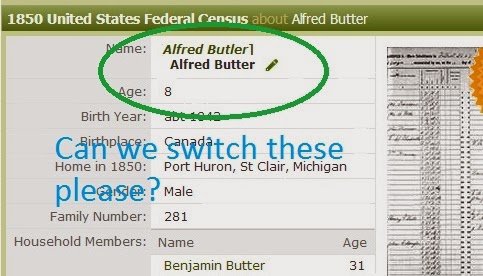
I'm stuck on Benjamin in 1860. I cannot find him. I do have him in the 1850 census in Michigan. The image below shows the individual database entry for one of the children living in his 1850 household. The name was originally transcribed as "Butter," but it's clear the name is actually Butler.

And there is the problem.

Ancestry.com has no recommendations for Alfred Butter. This is one of the few times when I really would like to see their recommendation. The problem is that there are none.


I thought if I clicked on the alternate spelling that I'd get recommendations for alternate records using that name. Nope.

All I got was a page indicating who suggested the alternate and why they suggested it. That's fine--another potential contact person.

But what I really would like to do is to be able to "switch" the names so that the suggested records pulled up are based on Alfred Butler, not Alfred Butter. That would help.

I'm betting that most of us with problem people occasionally have problems because of transcription errors.

I'm hoping for a change, but my gut tells me it won't happen. I'm still thinking my picture is on someone's dartboard at their corporate offices.


Updated on FamilySearch: Queens, New York Probates

This database is showing as updated on FamilySearch since our last posting:

New York, Queens County Probate Records, 1785-1950

09 December 2013

New or Updated on FamilySearch: Tennessee-Putnam and Cocke County Records

The following are showing as new or updated on FamilySearch since our last posting:


Tennessee, Putnam County Marriages, 1930-1961

Tennessee, Cocke County Records, 1860-1930

Why Blog When the Genealogical Cart is Ahead of the Genealogical Horse

How much should one blog about research in progress? It is a good question.

One of the main reasons for not blogging about in-progress research is that there is the chance that readers will take hypotheses about the individuals as being fact when they are not. These individuals may even credit me with  statements that I did not make.  There's also a chance that others will "use" my hypothetical statements to further their own research without giving me credit.

One of the main reasons for blogging is that the very act of writing often cleans the cobwebs out of the research and may allow one to reach out to others researching the same families. Past experiences indicate that the majority of potential relatives who stumble upon a blog post about the people for whom they are searching will never communicate with the poster of the blog entry.

But then again, most readers of published genealogies don't communicate with those authors either. And it certainly is less expensive and time consuming to write a blog post than it is to publish a book.

That all being said, I will keep blogging about in-progress research, making clear what is speculation and what is not.

The potential relative that got me to thinking about this process is Rufus D. Stephens, who resided in Ontario County, New York; Ontario, Canada;  and  St. Clair County, Michigan, at various times in the first half of the 19th century.

I often blog about Rufus, but have never really mentioned his connection to me. I try and avoid referring to him as "my" Rufus as I'm not certain whether he is "mine" or not. It is possible that I should not even be researching Rufus and that I've gotten the genealogical cart ahead of the genealogical horse.

Or maybe not.

Rufus may be the maternal grandfather of my known ancestor Florence Ellen (Butler) Sargent. Florence was born in the mid-1850s, probably in the state of Missouri. No birth or death record for Florence exists--that's part of the problem. In fact her name only appears on three records: her 1870 marriage, her 1880 census enumeration with her husband and her probable 1870 census enumeration with her parents. The first wife of the man presumed to be her father was named Margaret Stephens and it is presumed (based upon the ages of Benjamin's children) that Florence Ellen's mother was Margaret Stephens as well, although more work needs to be done.

So why Rufus D. Stephens? After all, Stephens is a common last name and one has to be careful grabbing any old Stephens and hypothesizing he is Margaret's father. And I have to remember that my connection to Margaret Stephens (Butler) is not solid either.

The reason for Rufus D. Stephens is that he is of the age to be Margaret (Stephens) Butler's father and he more importantly appears as a neighbor to Benjamin and his probable brother Arvin Butler in both Michigan and Ontario over a fifteen year time span. The appearance of Rufus as a neighbor to the Butlers in both locations is more than coincidental. But "more than coincidental" is not enough. I need more to connect Rufus to the Butlers.

And I also need to connect Margaret (Stephens) Butler to her children.

And that's why I'm researching Rufus as well as the others. It is possible that some record on Rufus during the time period he lived near the Butlers will reference Margaret or Benjamin Butler directly. The records that indicate they live in close proximity hint at a connection, but there may be other materials I have not yet located that may strengthen the connection.

Benjamin and Margaret (Stephens) Butler moved around quite a bit and have still not been located in the 1860 federal census. Perhaps some record on Rufus, perhaps a will, probate, or "heirship" deed will include residential information on his heirs.

If I wait until I have solid a solid connection to Rufus before I "research" him, I may never get that solid connection in the first place.


What Is Viz?

For those who did not see it, today's Genealogy Tip of the Day was about the abbreviation viz. I don't make a habit of reposting tips here, but thought it may be of interest.


07 December 2013

Santa in 1940 and Continued on the Next Page

This wraps up our "Santa in the Census" series.

The 1940 census finds Santa Claus still living in Marshall, Saline County Missouri (ED 98-21). Santa is working as a sewer worker.  There is no 1940 agricultural census to determine if Santa had any reindeer or not.

Seriously though, I never noticed that there is a box on the 1940 census to check if the entry is continued on the next page. I'm not certain I ever noticed it before as always look at the next page whenever I find any census entry.


It is enough to almost make me go back and look at all the other US censuses that were taken on standard forms to see if there's fine print in the corners that I have somehow missed or forgotten about.

After all, it's often the fine print that gets us in trouble.
-------------------------
Reminder: On the blog we don't cite items completely--that's just our preference. There is always enough information for a reader to determine where the original information was obtained. If there's not, I'm always glad to add it. Those who wish to learn more about the specifics of citation for genealogical purposes should consult Elizabeth Shown Mills' Evidence Explained: Citing History Sources from Artifacts to Cyberspace 2nd Edition. 


06 December 2013

A 1906 Era Porch Jumper


This is one of those few times I'm not writing about an actual relative of mine. I was looking for Philip Troutfetter, but he was not to be found in Ancestry.com's new Album of Criminals.

While searching Album of Criminals for various other extended family members, I saw an "occupation" which caught my eye: porch climber. I was not quite certain what a porch climber was.

This Chicago criminal shown below was listed as a professional porch climber.

International Association of Chiefs of Police, National Bureau of Criminal Investigation, ca. 1897 - ca. 1924. Album of Criminals, compiled 1906 - 1906. ARC ID: 1098589. Records of the Federal Bureau of Investigation, 1896 - 2008, Record Group 65; digital image, Ancestry.com
I'm inferring from this that he was agile enough to enter homes and buildings via the second story which he got to via the porch.

The physical description is interesting as well.

Hopefully readers don't find too many porch jumpers in their tree.

And of course, if one does then local court records are a good source for additional information.

What an Experienced Researcher Would Expect to be Relevant

My post on "Writing A Proof: Another Take" contained the phrase "Conduct a complete search of all relevant records that an experienced researcher would expect."

I've been thinking about that phrase, what it really means, and what I meant by it.

The Genealogy Proof Standard (from the Board for Certification of Genealogists' Genealogical Standards Manual) uses the phrase "exhaustive search" when it discusses the research process and what types of records are searched in answer to a specific research problem. Exhaustive search does not mean a tiring one. The phrase one uses is not what really matters. Too many people get bogged down in semantics when they should be getting bogged down in actual research (at least until they can see through the fog).

What matters is that a search be thorough--whether you say it is "complete" or "exhaustive" is a matter of debate.

What matters is that all relevant records to the problem be searched. It is difficult to define "relevant" exactly and precisely--it depends upon the problem. What is relevant depends upon the context. The key here is "all." Not just those records that are easy to access and not just those that the researcher has used enough times to be comfortable with, but any record that may address the issue at hand. Any.

And this is where experience also comes in to play.

When I had only researched a few of my families in one location, I simply didn't have enough experience to solve some of my other more difficult problems. That's why researching the families of others helps to make our own research better. Researching families outside our own (hopefully) gets us outside our comfort zone, outside our cultural and ethnic biases, and outside our "tried and true" assumptions.  Reading how others have solved similar problems in similar locations can help us get outside our own immediate zone as well. In fact, seeing how others have solved problems, what records they have used and how they have used them is an excellent tool in developing our analytical skills.

And that helps us when we go back to our own research.

So when you are trying to solve that problem, think "what are all the sources that an experienced researcher would use to answer this problem?" Be honest with yourself when using the word "experienced." to described your research skills.

I didn't use the word "expert" and I didn't use the word "professional." I used the word "experienced."

That was on purpose. Anyone can style themselves an expert or a professional.

But experience in using the appropriate records is what matters in solving most problems.

Most--not all.

You can also strengthen your research by reading the Board for Certification of Genealogists' Genealogical Standards Manual


FamilySearch Updates: SSDI; Idaho; Queens, NY, Washington State

New or updated on FamilySearch since our last posting:

93,620,511

05 December 2013

Historical Illinois Statutes

I posted this to Genealogy Search Tip of the Day, but thought I would post it here as well. I rarely post the same thing to both places, but this is an excellent resource for Illinois researchers:

For those with an interest in Illinois research, this portal at Western Illinois University will take you to links to digital images of 19th century Illinois state statutes, territorial laws, and more. The links on the left hand side allow you to navigate.

County Boundary Changes in Acts of the Session

Yesterday's post on finding older state statutes online had a reader asking why a genealogist would even care about these books.

There are many reasons and a fan of Genealogy Tip of the Day on Facebook gave an excellent example: county boundary changes.

These three pages (title page and pages relevant to my searching) actually are not from compiled state statutes, but rather are from the "Acts Passed at the First Session" of the 25th General Assembly of Kentucky in December of 1816. Session acts can be just as helpful as the compiled state statutes. The images that follow describe the change in the borders of Bourbon County, Kentucky--which explains why my ancestor's deeds of acquisition were recorded in one county while the deeds where it was sold were recorded in another.


Page 44


page 45


Keep in mind that there are generally three types of "legislation publication:"

  • slip laws-published immediately after passage
  • session laws-all the slips passed during a specific session, usually published after the session is over and in chronological order
  • compiled statutes-laws in effect in a jurisdiction at a specific point in time, usually arranged by topic and reflecting the most recent legislation passed 

I blogged about the specific change here--with a map to show the line change. The "straight line" that originally formed the northeast border of Bourbon County was changed out for geographic features.

04 December 2013

Finding Old State Statute Books-Three Free Places to Start

A fan on Genealogy Tip of the Day on Facebook asked about how to find old state statute books. Short of going to a university law library, here are some free online sources for digital copies of these materials.


  • Hathitrust.org -- start with subject search and use "yourstate" statute as an initial search--the year of publication cataloged in Hathitrust isn't always correct, so be careful using that. 
  • Internet Archive --search the "texts" 
  • Google Books
Determine if a nearby library has electronic access to a database that may contain additional digital copies of old state statutes. A reference librarian should be able to help you.


03 December 2013

Writing a Proof-Another Take


Personally I think too many people "stress" about writing a proof argument. And I think that there are a number of people who want others to think that they have discovered the "magic" formula. There is no magic formula and it's not as difficult as one thinks. It takes practice and more practice and little "magic."

Here is my take:

Conduct a complete search of all relevant records that an experienced researcher would expect

  • to provide a direct, specific answer to the question
  • to provide information, that when combined with a knowledge of the law, culture, and other records, would suggest an answer to the question.
Adequately and completely cite each source used.

Adequately and completely discuss your research procedure if a record that should be found cannot be found. Just "I didn't find it" is not enough--what records were searched (online, microfilm, courthouse, etc.) and how they were searched (what names, search terms, etc.) needs to be a part of this "can't find it" discussion.

Consider all possibilities--not just the one that "fits your notion."

Clearly discuss why certain possibilities are not supported by the records. If there are other conjectures about the persons involved that run counter to your conjecture, clearly state (with supported reasons) and analysis, why those other conjectures are not supported by currently available information. Do not simply discount them and do not simply ignore them. Doing so may indicate to others that you've not adequately researched the problem. 

Clearly state your assumptions. If you use a marriage record as evidence that someone was at least a certain age when they married, make certain you know what the statute in effect at the time said about the age of marriage.

Do all that and you are well on your way.


02 December 2013

Who Made What Digital Image and How? Ancestry.com's Headstone Applications for Military Veterans

I searched Ancestry.com's "Headstone Applications for Military Veterans, 1925-1963" for my relative and was surprised to find two references to him in the database. But this post isn't going to have the punch line that my ancestor accidentally has two military stones. There's more to the story than an oversight on the part of the Veteran's Administration and my ancestor being given a duplication stone.

The National Archives, in their microfilm publication M1916, microfilmed the tombstone applications for military veterans that were made from 1925 until mid-1941. Genealogists have used this publication on microfilm before it ever appeared on the internet in digital format.

A closer inspection of the "Original data" for Ancestry.com's "Headstone Applications for Military Veterans, 1925-1963" indicates that there are two sources for the images that appear in this database--one is the microfilm publication M1916. The other source is the applications themselves. It appears that Ancestry.com has converted M1916 to digital format, resulting in black and white images and that they have also made color digital images of the actual cards. Because the color digital images were made of the entire set of records, those cards that were in M1916 appear in the Ancestry.com database twice.

Once--from the microfilm.
Twice--from the digital photograph.

The microfilming only included the front of the card. The digital photography (done in color) included the front and the back of the card.

The database results and actual card images for Riley Rampley serve to illustrate.

The database results from the digital photograph of the original image:


The front of Riley's card from the digital photograph of the actual card:


The back of Riley's card from the digital photograph of the actual card:


The search results for Riley's card--from the digital image made from the NARA microfilm publication M1916:
The digital image of Riley's card made from the NARA microfilm publication M1916.

The back of the card was not microfilmed, hence there was no digital image of the reverse in black and white.

It's clear the same card is in both images. The frustrating part is that Ancestry.com is making me guess which image was made from the microfilm and which image was the actual picture that Ancestry.com (or their contractor) took.

Citations?

Users of these images will need to be careful. Citing the black and white image should indicate that the digital image was apparently made from the NARA M1916 publication. Citing the color image should make no such reference to the M1916 publication as that was apparently not used to create the color image.

One always needs to know what one is using.

30 November 2013

Santa Claus in the Census-1900, 1910, and 1930

In the interest of the season, we've posted the 1900, 1910, and 1930 census images of Santa Clause.
Sometimes the census taker does get it correct. This man's name actually was Santa Clause.

1900


Liberty Township, Saline County, Missouri--1900

1910

Liberty Township (ED 172), Saline County, Missouri, 1910


1930


Marshall, Saline County, Missouri, 1930


27 November 2013

Rounding Up or Rounding Down?

A recent blog post, "Aged 66 years and 6 months" generated some discussion about the age used for Belinda on her tombstone.

The blog post assumed (and made that assumption clear) that the age was correct. Our discussion was based upon that premise. Genealogists always have to make assumptions before any analysis can begin--it's the acknowledgement of those assumptions that is important. The point of that post was not about the assumption; it was about the analysis if that assumption were true.

The question was raised though that the age could have been rounded to the nearest month and, if that age was rounded, was it rounded up or rounded down? The thought that the age was rounded in some way is a legitimate one. The question is "how would the rounding have been done?"

Up or Down?


If the informant rounded up, they would have indicated Belinda was 66 years and 6 months if she was into the 5th month of her 66th year.

If the informant rounded down, they would have indicated Belinda was 66 years and 6 months only if she was over 66 years and 6 months and less than 66 years and 7 months.

My concern with the rounding is that I cannot be certain how it was done and it requires me to "guess" at how the rounder rounded the date. I'm not even certain who the rounder was--was it the son who paid for the stone or was it the stonecutter?

My thought is that "if" the months were rounded, they were rounded down and not up. My rationale for this is that even if I am 45 years and 10 months of age, I am likely to say I'm 45 and not as likely to say that I'm 46 (although I may say "I'm going on 46.").

Materiality?


The other concern is how big of a deal is this rounding? It only makes the month of birth one month different. The difference is likely to be significant in only rare cases where the researcher is trying to sort out two people with similar names born extremely close to one another.

My rule of thumb is to go with what the document says and indicate that the analysis is based upon that.


FamilySearch Indicates 1900 Census "Updated"

The FamilySearch website is indicating their 1900 census is "updated" as of today.

I'm not exactly certain what this means or how complete it is, because it indicates there are 16,996,689 records.

Those with an interest, can try it here

26 November 2013

New or Updated on FamilySearch: Orange Co. NY, Douglas Co. OR, Lee Co. IL

These are showing as new/updated since our last posting:

Oregon, Douglas County Records, 1850-1983

New York, Orange County Probate Records, 1787-1938

Illinois, Lee County Records, 1830-1954

Five Most Popular Genealogy Tip of the Day Posts Ever

According to our web stats, these are the five most popular Genealogy Tip of the Day posts since we started Genealogy Tip of the Day in May of 2007:

Feb 13, 2009
Aug 15, 2013
Apr 3, 2013
Nov 13, 2013
Oct 28, 2013

My Mayflower Lines

In the interest of the season, I've included my own Mayflower descents here--so far I have seven.  I don't blog about these very often as many of the lines are well-researched and I'm not as actively researching them as I am some of my other families. 

All of these lines of descent are through my paternal grandmother and include the following passengers:

  • John Tilley
  • Joan Hurst
  • Elizabeth Tilley
  • John Howland
  • Isaac Allerton
  • Mary Norris
  • Remembrance Allerton

The Tilley-Howland line


  • 1) John Tilley (1571 Henlow, England--first winter at Plymouth ) and Joan Hurst  (1567/8 Henlow, England--first winter at Plymouth )
  • 2) Elizabeth Tilley (1607 Henlow, England-1687 Swansea, MA)  and John Howland  ( )
  • 3) Hope Howland  (1629 Plymouth-1683 Barnstable, MA ) and John Hale Chipman  (1621 Dorchester, England-1708 Sandwich, MA )
  • 4) Lydia Chipman  (1653 Barnstable, MA-1730 Barnstable, MA ) and John Sargent  (1639 Charlestown, MA-1716 Malden, MA )
  • 5) Samuel Sargent (1688-Malden, MA-1721 Malden, MA )  and Elizabeth Pratt  (1693 Malden, MA-1760 Chelsea, MA )
  • 6) Thomas Sargent (1720 Malden, MA-1795) and Tabitha Tuttle (1724 Chelsea, MA -1804 Hubbardston, MA)
  • 7) Samuel Sargent (1748 Hubbardston, MA -1819 Marlboro, NH) and Deborah Sylvester (1751 Leicester, MA-1791 Marlboro, NH)
  • 8) Samuel Sargent (1774 Ashby, MA-1841) and Sarah Gibson (1774 Ashby, MA-1847)
  • 9) Clark Sargent (1805-1847 Winnebago County, IL) and Mary Dingman
  • 10) William Ira Sargent (abt. 1845 Ontario-1916 Peoria County, IL) and Ellen Butler
  • 11) Ida Mae Sargent (1874-1939 Quincy, IL) and George Trautvetter (1869 Tioga, IL-1934 Jacksonville, IL)
  • 12) Ida Trautvetter (1910 Hancock County, IL-1994 Carthage, Hancock, IL) and Cecil Neill (1903 Stillwell, Hancock, IL-1968 Keokuk, IA)

The Allerton line


  • 1) Isaac Allerton (1586-1659 New Haven, CT) and Mary Norris (1588-1622 Plymouth, MA).
  • 2) Remember Allerton (1614 Leiden, Holland-?) and Moses Maverick (died 1686 Marblehead, MA)
  • 3) Abigial Maverick ( 1644 Salem, MA-1685 Salem, MA) and Samuel Ward (1638 Hingham, MA-1690 Quebec)
  • 4) Martha Ward (1672 Salem, MA-1723 Ipswich, MA) and John Tuttle (1666 Ipswich-1715 Ipswich, MA)
  • 5) Samuel Tuttle (1691 Boston, MA-1742 Chelsea, MA) and Abigail Floyd (1691 Chelsea, MA -1773 Chelsea, MA)
  • 6) Tabitha Tuttle (1724 Chelsea, MA -1804 Hubbardston, MA) and Thomas Sargent (1720 Malden, MA-1795)
  • 7) Samuel Sargent (1748 Hubbardston, MA -1819 Marlboro, NH) and Deborah Sylvester (1751 Leicester, MA-1791 Marlboro, NH)
  • 8) Samuel Sargent (1774 Ashby, MA-1841) and Sarah Gibson (1774 Ashby, MA-1847)
  • 9) Clark Sargent (1805-1847 Winnebago County, IL) and Mary Dingman
  • 10) William Ira Sargent (abt. 1845 Ontario-1916 Peoria County, IL) and Ellen Butler
  • 11) Ida Mae Sargent (1874-1939 Quincy, IL) and George Trautvetter (1869 Tioga, IL-1934 Jacksonville, IL)
  • 12) Ida Trautvetter (1910 Hancock County, IL-1994 Carthage, Hancock, IL) and Cecil Neill (1903 Stillwell, Hancock, IL-1968 Keokuk, IA)

25 November 2013

Not Your Typical Trout Fetter

Spaces matter.

Names present all sorts of problems for the genealogist. Incorrect spellings, phonetic variations, omitted prefixes, and other name irregularities are the bane of the genealogist. They are also the bane of indexers as well.

Readers will know that one of my ancestral families has the last name of Trautvetter. The Germanic name presents spelling challenges for many records clerks and transcriptionists. The Kansas branch of my own Trautvetter family actually used the spelling of "Troutfetter." Searching for that spelling is what resulted in an interesting find.

I use Google Books quite a bit to locate references to various Trautvetters and Troutfetters. Of course, optical character recognition is not perfect and my results are not always "right." When I located a reference to "trout fetter" in a history from Westmoreland, County, Pennsylvania. I simply thought that Google Books had "seen" a space where none existed. I also thought I had found a totally new Troutfetter where none was previously known to exist.

I was wrong. There was a space. And there was no new Troutfetter.

The man's name was Amos Trout Fetter. Trout was his middle name and Fetter was his last name.

He was not a Troutfetter. He was a Fetter whose middle name was Trout. There's not apparent connection to my own family in this case.

The reminder for me was that I should remember "Fetter" as an alternate spelling for Troutfetter. Any longer surname can easily be "split." Trautvetter is a good example. This splitting could result in "last names" of Traut (if the "vetter" is omitted) or Fetter (if the "traut" is omitted).

But that's not what happened in this case as Amos Trout Fetter was no Troutfetter at all.

23 November 2013

Aged 66 Years and 6 Months on 6 July 1867

The tombstone for Belinda Newman in Linn County, Iowa, indicates she died at the age of 66 years and 6 months on 6 July 1867. That's what the contract for her tombstone indicated was to be the inscription on her tombstone.

Assuming that the age and date of death are accurate (which is perhaps a big assumption), when does this age and the date on which it was applicable imply Belinda was born?

It is important to remember that a stated age of 66 years and 6 months on Belinda's tombstone does not necessarily mean that Belinda was aged exactly 66 years and 6 months when she died. The number of days could simply have been left off the stone.  The lack of a date is not cause for concern. A tombstone is different from a death certificate form that may have blanks or places for the years, months, and days at the age at death. For the tombstone, it could have been there was not room for additional detail to be included in the inscription or the family could not or did not want to pay for the additional inscription charges.

Because of that, Belinda could have been:

  • as young as 66 years, 6 months, and 0 days.
  • as old as 66 years, 6 months, and one day shy of the next month.
If Belinda was 66 years and 6 months exactly, then she was born on 6 January 1801. This computation is fairly straightforward. 

If Belinda was 66 years, 6 months, and one day shy of the next month, on the next day (7 July 1867), she would have been exactly 66 years and 7 months of age. If Belinda had been exactly 66 years and 7 months of age on 7 July 1867, she would have been born on 7 December 1800.

The earliest date Belinda could have been born on was 7 December 1800.
The latest date Belinda could have been born on was 6 January 1801.

All of this analysis is subject to concerns about the accuracy of the information being provided. This post ony concentrates on using the age to determine a range of dates of birth.

An Obituary Challenge

part of the obituary of Michael Trautvetter,
21 December 1917, Warsaw Signal.
I'm not really one for genealogy "games" and "memes," but there are times when "challenges" can actually help your research. I just like the challenge to have a point or a purpose.

It has been decades since I read the obituary John Michael Trautvetter, who died near Tioga, Hancock County, Illinois, in 1917. The names of his survivors and their residences were all known to me. There was no news there.

As I looked at the "un-named" survivors, the great-grandchild struck my interest. My father is also a great-grandchild of Michael, and while he was not born until long after Michael's death, I thought my father's oldest first cousin was the surviving great-grandchild as she is significantly older than my father.

Apparently she was not old enough.  A quick look at my materials indicated this cousin was born after 1920, eliminating her as the great-grandchild referenced in the obituary.

So the question remained: who was this great-grandchild?

I have the names and dates of birth for the children and grandchildren of Michael's son George (my great-grandfather). I do not have the dates of birth for the grandchildren of Michael's other children. The obituary is a good motivation for me to nail down that information.

So, instead of a random genealogy "challenge," look at one of those obituaries for an ancestor that provides numbers of survivors without naming them.

Can you get the same numbers the obituary has? That's assuming the obituary is correct--which is another story altogether.

I've only got one great-grandchild of Michael to find. Thankfully it wasn't twenty or thirty.


22 November 2013

FamilySearch Update: New England Naturalization Petitions 1787-1931

This is showing as being updated on FamilySearch as of 22 November 2013. I think it was recently updated, but it's showing this date, so we'll post it:

New England, Petitions for Naturalization, 1787-1931