For anyone who is wondering, the purpose of this genealogical blog really is fairly clear: whatever crosses my research path that I feel worth mentioning, along with my opinion where I feel appropriate.
I'll only be mentioning websites, databases, etc. that I use in my own research. You won't see Hungarian, Russina, or Eastern European things mentioned here usually as my children have no ancestry from that region.
We'll mention things that I find irritating, enlightening, maddening, or interesting. That's a somewhat eclectic combination. My other blogs are pretty much opinion free--this one is not. Rootdig has no sponsors, although we do have some advertising. But, I'm not beholden' to anyone and you'll find no recycled press releases here either.
I don't jump on the latest bandwagon, am not always impressed with the latest gadgets, and don't get all goo-goo eyed over the latest bauble. I don't include "genealogy news," unless I think it impacts me or my research--there are other genealogy news websites.
And when I write something negative about something, I usually don't get emails--which either means no one who disagrees with me read it or thinks I generate enough traffic to worry about. Either way is fine with me!
Back to work.
12 December 2011
What Ancestry.com Can Give Genealogists for Christmas--THE OLD SEARCH
I've decided what Ancestry.com can give genealogists for Christmas--keeping the "old search."
Readers of my Genealogy Search Tip of the Day blog know that "new" search on Ancestry.com does not search based upon location correctly for advanced searches. Ancestry.com admitted it does not work and several users confirmed my results--despite emails insisting that it did work.
I gave up and went back to the old search. The old search works. It does what it is supposed to. This is the screen for my search for people with the last name of Green living in Linn County, Missouri, using the old search.
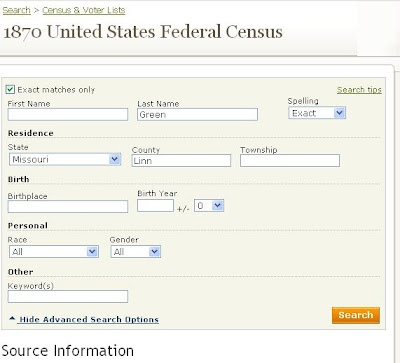
Guess what I got? Results from Pennsylvania? Kentucky? NO!
I got results from Linn County, Missouri, and ONLY Linn County, Missouri. Only 45 results!

This was what I needed from my search and results that the "new" search (I won't use the word "improved" as a modifier because it's not appropriate). Getting the results I requested is necessary for my analysis. Interestingly enough, one of the names is "Aloony," which I hope is not someone's attempt to make a comment about me (grin!).
I was a little happy about getting the results I searched for.
 If you like the "old" search--let Ancestry.com know loud and clear! Heck you can even email them a link to this post if you want. The address for this post is:http://rootdig.blogspot.com/2011/12/what-ancestrycom-can-give-genealogists.html
Genealogy Search Tip of the Day has a post on how to get to the old search. Feel free to share it with others.
Thanks to Linda M who reminded me that the old search works just fine. And my apologies to my high school English teacher for all the exclamation marks (she told me once that excessive use of them was immature--which I think it is). I rarely use them at all, but will in this post to accentuate the fact that I'm pleased the old search does what it is SUPPOSED to do.
Readers of my Genealogy Search Tip of the Day blog know that "new" search on Ancestry.com does not search based upon location correctly for advanced searches. Ancestry.com admitted it does not work and several users confirmed my results--despite emails insisting that it did work.
I gave up and went back to the old search. The old search works. It does what it is supposed to. This is the screen for my search for people with the last name of Green living in Linn County, Missouri, using the old search.

Guess what I got? Results from Pennsylvania? Kentucky? NO!
I got results from Linn County, Missouri, and ONLY Linn County, Missouri. Only 45 results!

This was what I needed from my search and results that the "new" search (I won't use the word "improved" as a modifier because it's not appropriate). Getting the results I requested is necessary for my analysis. Interestingly enough, one of the names is "Aloony," which I hope is not someone's attempt to make a comment about me (grin!).
I was a little happy about getting the results I searched for.

Genealogy Search Tip of the Day has a post on how to get to the old search. Feel free to share it with others.
Thanks to Linda M who reminded me that the old search works just fine. And my apologies to my high school English teacher for all the exclamation marks (she told me once that excessive use of them was immature--which I think it is). I rarely use them at all, but will in this post to accentuate the fact that I'm pleased the old search does what it is SUPPOSED to do.


11 December 2011
It's Not Working and There's No Books
Ancestry.com's exact advanced searches still do not work ( at least for 1870--just checked).
This blogger finds it ironic that FamilySearch's denial of book vendors for RootsTech raises a huge furor while there is little concern that the search interface at Ancestry.com is working incorrectly for some searches. RootsTech is FamilySearch's conference and (whether I agree with the decision or not), they can decide to run it how they see fit. Those that do not like it can choose not to attend.
However, Ancestry.com's exact advanced searches USED to work and now don't. To me, that's a more irritating problem because the search interface implies that certain search parameters can be set and the user can expect them to be matched. Book vendors I can find. Books I can order. Searches that don't work they way they are supposed to ARE a problem.
Just my two cents.
This blogger finds it ironic that FamilySearch's denial of book vendors for RootsTech raises a huge furor while there is little concern that the search interface at Ancestry.com is working incorrectly for some searches. RootsTech is FamilySearch's conference and (whether I agree with the decision or not), they can decide to run it how they see fit. Those that do not like it can choose not to attend.
However, Ancestry.com's exact advanced searches USED to work and now don't. To me, that's a more irritating problem because the search interface implies that certain search parameters can be set and the user can expect them to be matched. Book vendors I can find. Books I can order. Searches that don't work they way they are supposed to ARE a problem.
Just my two cents.
Genealogy Fundamental Webinars
Necessity is often the mother of invention.
Hosting our genealogy webinars is not free and requires a monthly account regardless of how many times it is used. The holidays are not good time to get extensive work done, especially work that requires extensive preparation. Several years ago, I prepared a series of genealogy fundamental items, using course materials I developed years ago as a starting point.
We've decided to use these fundamental materials to create a series of short (20 minutes long) sessions on a variety of specific document types. We won't discuss how the items were located, rather on how the information they contain, what it means, how to interpret it, where to go next, and how to cite. That's enough and that's enough for these short sessions.
They are geared towards genealogists without a lot of experience or those who wish to return to some basic skill development.
More details, including topics, can be seen our our website. Our registration fee is only $1.99 per session.
Hosting our genealogy webinars is not free and requires a monthly account regardless of how many times it is used. The holidays are not good time to get extensive work done, especially work that requires extensive preparation. Several years ago, I prepared a series of genealogy fundamental items, using course materials I developed years ago as a starting point.
We've decided to use these fundamental materials to create a series of short (20 minutes long) sessions on a variety of specific document types. We won't discuss how the items were located, rather on how the information they contain, what it means, how to interpret it, where to go next, and how to cite. That's enough and that's enough for these short sessions.
They are geared towards genealogists without a lot of experience or those who wish to return to some basic skill development.
More details, including topics, can be seen our our website. Our registration fee is only $1.99 per session.
Casefile Clues for the Holidays!
Give yourself or that genealogy friend the gift that lasts all year--Casefile Clues. It is the perfect gift for that hard to buy for genealogist.
If you are giving a friend a gift subscription, please indicate their name/email address in the comments/notations field when making your order--or simply email me that information at mjnrootdig@gmail.com after your order has been processed.
Thanks....and Happy Holidays!
If you are giving a friend a gift subscription, please indicate their name/email address in the comments/notations field when making your order--or simply email me that information at mjnrootdig@gmail.com after your order has been processed.
Thanks....and Happy Holidays!
10 December 2011
Genealogy Transcriber
I've gotten a couple of emails about the Daily Genealogy Transcriber, so I thought I'd mention it here as this blog is where I normally post opinions and other ilk of that genre.
My original purpose behind the Daily Genealogy Transcriber was to help genealogists see how indexers and transcribers may make "mistakes." It really was not intended to be a guide to complete, entirely accurate transcription. Most of us deal with misreadings, errors, and honest mistakes by indexers every day (and thanks to them for indexing things for us!). Because of that, seeing how things can be read incorrectly, I think is an advantage to any genealogist who uses digital indexes to records.
Because of that, I often do not post the entire image--sometimes I do, but not always. The idea is to see how things get read "cold." That can't always be done if one has the entire series of records.
If the document or record is on your family, should you use other entries to help interpret the entry? Yes. Should you use other documents and sources to help you in your interpretation? Yes.
But at Transcriber, we're trying to help genealogists see how "errors" get in digital indexes and those indexers often do not have other documents on the family to help them in their analysis.
You can look at today's entry here.
My original purpose behind the Daily Genealogy Transcriber was to help genealogists see how indexers and transcribers may make "mistakes." It really was not intended to be a guide to complete, entirely accurate transcription. Most of us deal with misreadings, errors, and honest mistakes by indexers every day (and thanks to them for indexing things for us!). Because of that, seeing how things can be read incorrectly, I think is an advantage to any genealogist who uses digital indexes to records.
Because of that, I often do not post the entire image--sometimes I do, but not always. The idea is to see how things get read "cold." That can't always be done if one has the entire series of records.
If the document or record is on your family, should you use other entries to help interpret the entry? Yes. Should you use other documents and sources to help you in your interpretation? Yes.
But at Transcriber, we're trying to help genealogists see how "errors" get in digital indexes and those indexers often do not have other documents on the family to help them in their analysis.
You can look at today's entry here.
09 December 2011
Naturalization Records in US pre-1920 Webinar Recording
United States Naturalization (NEW!) Records pre-1920 - This presentation is an overview of naturalization records in the United States prior to 1920, focusing on locating and understanding the records. Women's citizenship and derivative citizenship are also included. The recorded webinar and handout can be ordered for immediate download for $8.50.
If you paid to attend and were unable, please email me for the complimentary download link.
If you paid to attend and were unable, please email me for the complimentary download link.
Married to An Alien
From the Ancestry Daily News, 11/28/2001
Married to An Alien
A lady born in New York State is listed as an alien--why?!?
The problem centers around the history of women in regards to naturalization. I must admit the census entry confused me. The wife was a native of the state of New York State and was listed in the 1920 census as an unnaturalized alien. There is an "x" in the box for her year of immigration to the United States.
All other records clearly indicated the individual in question, Mary Verikios, had been born in New York State. While looking at other individuals on the same census page, I noted that a female neighbor born in Wisconsin was also listed as an alien with no date of naturalization or immigration. The commonality was that both ladies were married to men who were immigrant aliens. This connection warranted further study. It turned out that for these two ladies (and thousands of others), their choice of a husband impacted their citizenship.
The census entries for both women indicate they were probably married around 1910. I learned that under the law in effect at that time, both women would have lost their citizenship upon their marriage to an alien. To further compound the problem, courts during this era and for some time before frequently held that women derived their citizenship status from that of their husband. There were exceptions (single women filing homestead claims were sometimes naturalized whether they were a widow or had never been married).
The history of naturalization in the United States is somewhat complex. The complexity is aggravated for women by the fact that the laws regarding naturalization and females were ambiguous, especially before 1907. For a significant portion of American history, a woman's citizenship status was derived from the status of her husband. In many cases immigrant women were naturalized "by default" upon their marriage to a citizen or upon their foreign-born husband obtaining citizenship. This derivative type of citizenship is the reason there are few naturalization records for immigrant women for most of American history. For those who were "naturalized by marriage" there generally is no mention of them in any records before 27 September 1906, when Congress standardized the naturalization process and required names of spouse and children on naturalization paperwork. Also, until women received the right to vote, there was little reason for many to bother with the expense and procedure of naturalization. However, there are occasionally naturalization records for women in the 1880s, 1890s and later. Many of the children "naturalized by default" via their father's naturalization, but not listed specifically, later went through the naturalization process themselves.
To reduce confusion, here is a brief chronology relevant to the problem at hand:
1906
The Basic Naturalization Act was passed on 27 September 1906, which standardized the naturalization process throughout the United States. Records after this date are more consistent than those before. No longer could just any court perform a naturalization.
1907
On 2 March 1907 an act was passed wherein a wife's citizenship status was determined by the status of her husband. Here is where the confusion begins to get worse. For women who immigrated after this act (and before later changes were enacted), there was no real change from before (unless their husband was already a U.S. citizen). However, it was different for U.S.-born citizen females who married an alien after this date. These women would lose their citizenship status upon marriage to an alien. Many of these women would later become citizens again upon their husband's naturalization. Women who married men who were racially ineligible to naturalize lost their ability to revert back to their pre-marriage citizenship status.
1922
On 22 September 1922, Congress passed the Married Women's Act, also known as the Cable Act. Now the citizenship status of a woman and a man were separate. This law gave each woman her own citizenship status. This act was partially drawn in response to issues regarding women's citizenship that occurred after women were given the right to vote. From this date, no marriage to an alien has taken citizenship from any U.S.-born woman. Females who had lost their citizenship status via marriage to an alien could initiate their own naturalization proceedings.
1936
This act effected U.S. citizen women whose marriage to an alien between the acts of 1907 and 1922 had caused them to lose their citizenship status. These women, if the marriage to the alien had ended in death or divorce, could regain their citizenship by filing an application with the local naturalization court and taking an oath of allegiance. Those women still married to their husband were not covered under the act and these individuals would have to go through the complete naturalization process.
1940
In 1940, Congress allowed all women who lost their citizenship status between 1907 and 1922 to repatriate by filling an application with the local naturalization court and taking an oath. The complete naturalization process was no longer necessary for any woman whose marriage between 1907 and 1922 caused her to lose her citizenship status.
How Does This Impace Marie?
Here's where it gets a little confusing.
Marie's husband, Peter Verikios, was naturalized in 1934. Marie and Peter divorced in 1940. Marie subsequently married another U.S. citizen a few years later. None of these events made a difference in Marie's status after she married Peter, for they all took place after the Cable Act of 1922, which separated a woman's citizenship status from that of her husband. Her marriage to Peter between 1907 and 1922 was the "problem" in regards to her citizenship status.
Where Should I Go?
It might be worth looking into possible records whereby Marie regained her citizenship status. Given the confusion that surrounded the citizenship status of women, there might be no record at all. In this case, since Marie's origins in New York State are somewhat foggy, accessing the records may shed some light on her life before she came to the Chicago area.
That one little "X" in the 1920 census really gave me a history lesson.
Sources:
Smith, Marian L., "'Any woman who is now or may hereafter be married . . .' Women and Naturalization, ca. 1802-1840," National Archives and Records Administration Web Site: (http://www.archives.gov/publications/prologue/1998/summer/women-and-naturalization-1.html), originally published in 'Prologue: Quarterly of the National Archives and Records Administration,' Summer 1998, vol. 30, no. 2
Szucs, Loretto D.,
 They Became Americans: Finding Naturalization Records & Ethnic Origins, Salt Lake City, Utah, Ancestry, Inc., 1998.
Every Little Detail
reprinted from the Ancestry Daily News
Michael John Neill - 6/15/2005
Those Short Phrases
Three or four words "squeezed" in at the very bottom of a document may be the largest clue of all, even if the handwriting is microscopic. Mrs. Barbara Pickert marries in Hancock County, Illinois, in 1859. A slip of paper included in with the marriage indicates in tiny script at the very bottom of the page that Mrs. Pickert "has no lawful husband living."I almost ignored the reference. Barbara's first husband Peter Bieger (or Pickert) was known to have been dead by late 1855. It was initially thought that the reference was to him. The longer I thought the more odd it seemed that the phrase "no lawful husband living" was used when the shorter term of "widow" would have sufficed. Later research revealed that Barbara was apparently married for a short time in 1856 to a George Fennan who abandoned her--hence the phrase "no lawful husband living."
How Long Have I Known You?
There may be references in a record or document that have no bearing on the case, but that do have bearing on the family being researched. Court testimony from an 1877 court case indicated that Christian Williams had known my ancestor Mimke Habben for at least twenty years. Mimke immigrated to the United States in the 1860s. If I had not known where Mimke was from in Germany, my research should have concentrated on Christian. Since Christian had known my ancestor since at least 1857, they had known each other in Germany. Court testimony and military pension papers are great sources for finding references to individuals who have known your ancestor for a specified period of time.
What Does It Mean?
In a guardianship record from Kentucky in 1814, my ancestor is referred to as an infant. In 1815 she marries. Before anyone draws any inappropriate conclusions, it should be noted that the guardianship record is using the legal definition of infant. Consequently the 1814 reference to Melinda Sledd as an infant only indicates she is under the legal age of majority, not that she is a newborn. Viewed in this light her 1815 marriage to Augusta Newman is no longer viewed as suspect.
Are They Sharing Luggage?
When one of my ancestral families immigrated in 1853, the passenger manifest indicated that they and another couple were sharing a set of luggage. The clue was not obvious--just a bracket on the far right-hand side of the manifest indicating that three bags belonged to the families of George Trautvetter and George Mathis. I kept the Mathis family in mind as I researched and eventually discovered that George Mathis' wife was George Trautvetter's niece.
How Does One Notice These Clues?
Sometimes it can be difficult to pick up on subtle references or turns of a phrase. The way to avoid overlooking these clues is to make certain that:
Obtain the Original Document
Transcriptions may occasionally leave out pertinent details. The Trautvetter and Mathis families located on the passenger lists were originally located in the series Germans to America. This finding aid, while a great help, did not include the notation that the two families were sharing luggage. Of course, this was a significant clue only discovered by viewing the actual manifest.
Type the Document
Transcribing a document, forces the transcriptionist (you) to look at every word more closely. It is easy to overlook clues when you are reading silently. I know of one genealogist who received a transcription of a document that had an error. She could not determine what the error was. When typing up the transcription as part of a report on the entire family, she realized how the likely error occurred and was able to make additional headway with her research. Reading the document over and over did not bring about the revelation.
Read the Document Out Loud
While this may not make you immediately popular with others in your household, it can make it easier to notice details based upon the way words could have sounded to your ancestor. Sometimes when we read something aloud or hear it read something "clicks" that did not click before.
Read the Document Backwards
Again this forces the reader to look at every word. While the document probably won't make too much sense this way, it may cause you to notice a word or phrase that you had previously overlooked. And that is the entire point.
Create a One-Page Summary of Your Problem
Those who go with me on my research trips are encouraged to submit a one-page problem for me to review. While the limitation to one page makes for less to read, it forces the genealogist to narrow their problem and determine what details are important. While there are situations where one page is not sufficient, the hope here is to make the person look at all the details and decide which details are crucial to the problem.
The mark, the twist of phrase, the scribbled reference at the bottom of the page--it may be meaningless, but maybe not. But if you never notice it and analyze it, you will never know!
Michael John Neill - 6/15/2005
Every Little Detail
They say "the devil is in the details."While I'm never certain who this mysterious "they" is, one thing is for certain: The details can create headaches or opportunities, depending upon whether they are noticed and how they are interpreted.Those Short Phrases
Three or four words "squeezed" in at the very bottom of a document may be the largest clue of all, even if the handwriting is microscopic. Mrs. Barbara Pickert marries in Hancock County, Illinois, in 1859. A slip of paper included in with the marriage indicates in tiny script at the very bottom of the page that Mrs. Pickert "has no lawful husband living."I almost ignored the reference. Barbara's first husband Peter Bieger (or Pickert) was known to have been dead by late 1855. It was initially thought that the reference was to him. The longer I thought the more odd it seemed that the phrase "no lawful husband living" was used when the shorter term of "widow" would have sufficed. Later research revealed that Barbara was apparently married for a short time in 1856 to a George Fennan who abandoned her--hence the phrase "no lawful husband living."
How Long Have I Known You?
There may be references in a record or document that have no bearing on the case, but that do have bearing on the family being researched. Court testimony from an 1877 court case indicated that Christian Williams had known my ancestor Mimke Habben for at least twenty years. Mimke immigrated to the United States in the 1860s. If I had not known where Mimke was from in Germany, my research should have concentrated on Christian. Since Christian had known my ancestor since at least 1857, they had known each other in Germany. Court testimony and military pension papers are great sources for finding references to individuals who have known your ancestor for a specified period of time.
What Does It Mean?
In a guardianship record from Kentucky in 1814, my ancestor is referred to as an infant. In 1815 she marries. Before anyone draws any inappropriate conclusions, it should be noted that the guardianship record is using the legal definition of infant. Consequently the 1814 reference to Melinda Sledd as an infant only indicates she is under the legal age of majority, not that she is a newborn. Viewed in this light her 1815 marriage to Augusta Newman is no longer viewed as suspect.
Are They Sharing Luggage?
When one of my ancestral families immigrated in 1853, the passenger manifest indicated that they and another couple were sharing a set of luggage. The clue was not obvious--just a bracket on the far right-hand side of the manifest indicating that three bags belonged to the families of George Trautvetter and George Mathis. I kept the Mathis family in mind as I researched and eventually discovered that George Mathis' wife was George Trautvetter's niece.
How Does One Notice These Clues?
Sometimes it can be difficult to pick up on subtle references or turns of a phrase. The way to avoid overlooking these clues is to make certain that:
- You know the definitions of all words in the document.
- You determine if any words have specific legal definitions different from the way the word is used outside the legal system.
Obtain the Original Document
Transcriptions may occasionally leave out pertinent details. The Trautvetter and Mathis families located on the passenger lists were originally located in the series Germans to America. This finding aid, while a great help, did not include the notation that the two families were sharing luggage. Of course, this was a significant clue only discovered by viewing the actual manifest.
Type the Document
Transcribing a document, forces the transcriptionist (you) to look at every word more closely. It is easy to overlook clues when you are reading silently. I know of one genealogist who received a transcription of a document that had an error. She could not determine what the error was. When typing up the transcription as part of a report on the entire family, she realized how the likely error occurred and was able to make additional headway with her research. Reading the document over and over did not bring about the revelation.
Read the Document Out Loud
While this may not make you immediately popular with others in your household, it can make it easier to notice details based upon the way words could have sounded to your ancestor. Sometimes when we read something aloud or hear it read something "clicks" that did not click before.
Read the Document Backwards
Again this forces the reader to look at every word. While the document probably won't make too much sense this way, it may cause you to notice a word or phrase that you had previously overlooked. And that is the entire point.
Create a One-Page Summary of Your Problem
Those who go with me on my research trips are encouraged to submit a one-page problem for me to review. While the limitation to one page makes for less to read, it forces the genealogist to narrow their problem and determine what details are important. While there are situations where one page is not sufficient, the hope here is to make the person look at all the details and decide which details are crucial to the problem.
The mark, the twist of phrase, the scribbled reference at the bottom of the page--it may be meaningless, but maybe not. But if you never notice it and analyze it, you will never know!
08 December 2011
John Ehmen's Headstone in Camp Point, Illinois

I'm going to have to research John Ehmen a little more.
This is the Application for a Headstone for him that appears in a database recently released on the FamilySearch website.
This application is really interesting in that it provides his date and place of birth in the upper left hand corner and provides his death date and location as well. Of course, all that information is secondary, as is the fact that he was in a hospital in Memphis, Tennessee.
Why he was in Galesburg is a mystery at this point. I'll have to add that to the list. I'm thinking that this individual may be good fodder for an upcoming Casefile Clues article.
Source:
United States. Quartermaster General. Applications for Headstones for U.S. Military Veterans, 1925-1941. Record Group 92, NARA publication M1916. United States. Federal Archives and Records Center. Washington D.C.
Released from the Chain Gang
I am usually on the lookout for signatures for Daily Genealogy Transcriber.
This is part of a World War II draft card from a databaseof cards for "young men" that was recently released on Ancestry.com. Ancestry.com refers to it as the U.S. WWII Draft Cards Young Men, 1898-1929 database.
 It just goes to show that you never know what you will find. I decided not to post the whole name or the whole card--just in case the person was still alive. He was born in 1921 and a quick search of the SSDI failed to locate him.
This is part of a World War II draft card from a databaseof cards for "young men" that was recently released on Ancestry.com.
Ancestry.com refers to it as the U.S. WWII Draft Cards Young Men, 1898-1929 database.
Part of the card I was going to use is shown here--apparently this person had just been released from the County Chain Gang.

07 December 2011
New, But HOW?

Can someone tell me "how" the 1880 United States Federal Census on Ancestry.com is "new?" The database and the images have been on the site for years. Is it "new" enough that I should try again for people I cannot locate? Is it newer or better images (the ones before were pretty good)? Don't get me wrong, I am a big fan of Ancestry.com, but this "new" stuff with NO explanation of "how" it is new is highly irritating.
I went to the blog for Ancestry.com and got no information there either. A sentimental post about Pearl Harbor (which was nice), but nothing about the 1880 United States Census being "new" or modified.
Who Are These People--Probably Near Basco, Hancock County, Illinois
 [reposted 8 Feb 2010]
The young lady on the far right is Tena/Trientje Janssen Ufkes (1895-1986).
Tena was born in Bear Creek Township in February of 1895 and died in Carthage, Hancock County, Illinois, in 1986.
I do not know who the others are in the picture. This photograph was one that my grandparents had. Tena's son John H. Ufkes (1917-2003), was my grandfather.
Any suggestions as to who the others are would be greatly appreciated.
06 December 2011
December Webinars-4 for $25
We have four webinars upcoming in December before we break for the holidays:
- DeedMapper
- Pre-1920 Naturalization Records
- Analyzing pre-1850 American Census Records
- Sarah and Susannah: Two 18thCentury Virginia Women and their property
If you'd like to sign up for all of them, you can do so at the total price of $25 (save $7--that's lucky!) by using this link on this page. The $25 for all four rate is NOT on the main webinar page. If you can't attend, have connectivity issues, or other problems, you can get the downloadable version of the webinar after it has been recorded and processed.
Signed up for an earlier one, but missed it? Email me at mjnrootdig@gmail.com and we'll send you the download link at no charge.
Palatines Indianapolis Genealogy Conference June 2012
I will be one of two featured speakers at the annual National Societies of Palatines to America conference in Indianapolis from 14-16 June 2012. I'm looking forward to making my presentations there and hope blog readers will join me if they live in the area and have an interest. You don't have to be a society member to attend the conference.
My topics are:
My topics are:
- Crossing the Pond
- Online Search Techniques
- Germanic Research with Ancestry.com
- German Genealogy Websites
- Creating Your Own Blog
- What's New for German Researchers on FamilySearch
- Determining Your Own Migration Chain
Warren Bittner will also be presenting additional German topics.
Mark your calendar now. I'm looking forward to meeting attendees and blog readers as well.
Update on Non-Working Advanced Searches At Ancestry.com
I just tried it again and there is no change in the way advanced searches are not working at Ancestry.com as discussed earlier on my Search Tip of the Day blog.
I did receive an answer from Ancestry.com--one of their executives. The response was pleasant and indicated they were working on the problem, but my comments about beta testing, things being put out too quickly, the need for a little better testing, were not even mentioned, which makes me think that the process will not change.
I'll keep checking to see if the search has been fixed, but I am no longer holding my breath that it will be anything relatively quick.
Personally I still think there's too big of a rush to put out new things and not enough concentration on the "old-timers."
And I'm starting to think my complaints actually fell on deaf ears and that Rootdig.com doesn't generate enough traffic for Ancestry.com to even worry about.
Oh well. I'll still be researching my genealogy in thirty years. The executives at Ancestry.com will have moved onto other things long before that.
And that's the problem.
I did receive an answer from Ancestry.com--one of their executives. The response was pleasant and indicated they were working on the problem, but my comments about beta testing, things being put out too quickly, the need for a little better testing, were not even mentioned, which makes me think that the process will not change.
I'll keep checking to see if the search has been fixed, but I am no longer holding my breath that it will be anything relatively quick.
Personally I still think there's too big of a rush to put out new things and not enough concentration on the "old-timers."
And I'm starting to think my complaints actually fell on deaf ears and that Rootdig.com doesn't generate enough traffic for Ancestry.com to even worry about.
Oh well. I'll still be researching my genealogy in thirty years. The executives at Ancestry.com will have moved onto other things long before that.
And that's the problem.
05 December 2011
Reposting Philip Troutfetter's Arrest
Troutfetter is Bagged in Boston
 [reposted from 2008]
You have to love headlines.
This one comes from a 1902 Colorado's Gazette-Telegraph, which was located on GenealogyBank. Philip Troutfetter was said to have been involved in the Cuban postal frauds, but it appears that he only associated with one of the men involved and was not actually involved himself.
Source: Date: 1902-04-11;
Paper: Gazette-Telegraph
A second clipping from the Springfield Republican also mentions Troutfetter. We've blogged about Philip before, but occasionally run across a new clipping that mentions some snippet of his life I've not discovered elsewhere. He was never convicted and died at his parents' home in rural Kansas in the early 1900s.

Source: Date: 1902-04-11;
Paper: Gazette-Telegraph
A second clipping from the Springfield Republican also mentions Troutfetter. We've blogged about Philip before, but occasionally run across a new clipping that mentions some snippet of his life I've not discovered elsewhere. He was never convicted and died at his parents' home in rural Kansas in the early 1900s.

The second clipping is from:
The original clippings appear on GenealogyBank.
Date: 1900-07-26;
Paper: Springfield [Mass] Republican
The original clippings appear on GenealogyBank.
104 Issues of Casefile Clues for $25
We are wrapping up our second year of Casefile Clues issues--104 issues of genealogical information, advice, methodology, and "how-to" information. Casefile Clues accepts no advertising, is not trying to sell you anything and concentrates on excellence in writing and research. Normally a year of Casefile Clues is $17, but we're offering our first two years of issues as a set of $25 total. Each issue averages 8 pages.
Purchase all year 1 and year 2 issues for $25. Issues delivered via email as PDF files.
Year 1 Issue Topics
Reposting as I messed up all the navigation on the blog:
Here are Year 1 issue titles (in reverse order)
Here are Year 1 issue titles (in reverse order)
- 52--Benjamin Butler in 1880 and 1870--correlating an 1880 and 1870 census enumeration when the head of household has a different first name
- 51--Clarifying Clara--a widow's War of 1812 Bounty Land application
- 50--Special Examiner's Report--Discussion of testimony taken by a Special Examiner in a Union Civil War Pension File
- 49--Levi Rhodes' War of 1812 Pension--A discussion and and an analysis of a War of 1812 pension issued in 1871.
- 48--Determining Your Own Chain of Migration--Ways to determine the unique migration chain that your ancestor took
- 47--Finding the Ellen--Finding someone in an 1870 census when she's a child and I don't have the names of the parents. Discusses proximity searches, eliminating false matches, etc.
- 46--Ira Located--the correct marriage record for Ira Sargent was located. This issue includes the image and a complete transcription, an analysis, additional searches that were conducted, and where to go next.
- 45--Organizing My Search for Ira--discusses brainstorming to locate the parents of Ira Sargent, how and why records were prioritized, and how records would be searched.
- 44--Philip Troutfetter in the Special Collections of the Kansas State Historical Society--fraud, postal investigations, and abandoned wives--all from one relative.
- 43--Unacquiring Property--ways your ancestor might have "disposed" of his real estate.
- 42--Multiple Johns--two brothers with the exact same name--apparently.
- 41--Brick Walls from A to Z--the title says it all--ideas for breaking those brick walls
- 40--Finding John--analysis, including charts and maps, in an attempt to find a missing 1870 census enumeration.
- 39--Multiple Marias--Analyzing more than one 1893 obituary for a Swiss immigrant in Iowa.
- 38--From their Mouth to Your Screen. Discusses all the "filters" information passes through.
- 37--Pullman Car Company Employment Records. Discusses several employment records from the Pullman Car Company in Chicago. Discusses William Apgar, Thomas Frame, Louis DeMar.
- 36--Where are they in 1840? Analyzes an individual who is "missing" from an 1840 census. Includes a discussion of how he was "found" and how land records actually solved the problem. Discusses Abraham Wickiser.
- 35--A 1910 Birth. Analyzes primary and secondary sources for a date and place of birth in 1910 and how differences might not be all that different. Discusses Ida Trautvetter.
- 34--Ready to Go? Discusses some things to contemplate regarding your genealogy material before you die.
- 33--Where there is a Will there is Confusion. Analyzes an early 19th century will from Maryland and what the different bequests likely mean and what potentially brought them about. Also discusses different ways some things can be interpreted. Discusses John DeMoss.
- 32--When There is No Probate. Some things to think about when there is no probate file.
- 31--Analyzing the Mortgage. Discusses an 1870 era mortgage in Illinois. Discusses John Ufkes and Rolf Habben.
- 30--Behind the Scenes Chaos. Discusses the importance of thinking about what "caused" a record to be recorded.
- 29--Un-American Activity. Discusses an invesigation by the fore-runner of the FBI into a German-American family in World War I. Discusses the Fecht family.
- 28--Do You Ear What I Ear? Discusses things to remember about how things are heard.
- 27--Analyzing Andrew Trask. Discusses work on an Mass. native (born ca. 1814) who lived in St. Louis, southern-Illinois, and western Illinois where he died in the 1880s. Focuses on analyzing and working on later records to discern patterns, etc. Discusses Andrew Trask.
- 26--Using Google Books.
- 25--Finding Valentine. Steps in locating a man whose only real mention is in an 1870 era estate settlement. Discusses how I organized my search for him.
- 24--The Brick Wall is in Your Head. Talks about ways you may have made your own genealogical brick wall.
- 23--You Ask and I Wonder. Things that pop in my head when a person asks a certain genealogical question.
- 22--Crossing the Pond.
- 21--One Clipping Leads to More.
- 20--Organizing 1870 Census Search--thoughts on organizing online census searches.
- 19--Public Sale--Analyzing an old sale bill.
- 18--Analyzing the Biography--Charting and Organizing what You Know Using a Biography
- 17--Working with the Professional. Getting started with the professional genealogist who is performing Chicago area work for me.
- 16--A Lot from Barbara's Lot. Clues from a series of records on a small lot in a town in rural Illinois betwen 1856 and 1905.
- 15--Finding Gesche's Girls. Tracking down an "evaporating" German native who "condensed" somewhere in the United States.
- 14--Jumpstarting Your Research. Just some ideas to get you started.
- 13--Brick Walls and the Census Taker
- 12--The Heirs Complete the Homestead
- 11--Is the Wrong Name Correct?
- 10--Connecting the Iras. Working to determine if two men of the same name are the same man.
- 09--Pre-1850 Census Analysis. Analzing pre-1850 census records for a family to determine the household structure. Discusses Thomas and Sarah Sledd.
- 08--Platting Out Thomas Sledd's Heirs. Platting out the estate division of the Thomas Sledd estate in Kentucky in the 1830s. Discusses Thomas Sledd family.
- 07--Looking for Ira's Lucretia. Working on my "brick wall" Ira through his sister Lucretia. mid-to-late nineteenth century work.
- 06--The Civil War Pension file of Riley Rampley. An overview of a Union Civil War pension record.
- 05--Finding a Chicago Christening. How a 1913 era Chicago christening record was found. Discusses Anna Apgar.
- 04--Multiple Parents
- 03--Preemption Claim. The Missouri pre-emption land claim of John Lake. Discusses John Lake.
- 02--Passport Records. Discusses an early twentieth century passport application. Discusses Robert Frame.
- 01--Lessons from an Estate Record. Analyzes an 1870 era Illinois set of estate records.
Year 2 Issues Of Casefile Clues
Topics from the first 51 issues of year 2 are shown below (order them here):
- Volume 2-Number 1--Problem-Solving--a variety of techniques for breaking through those brick walls.
- Volume 2-Number 2--A 1907 Committal--An insanity record.
- Volume 2-Number 3--A 1921 Divorce--looking at a 1921 era divorce from Chicago
- Volume 2-Number 4--Leaving John's Hands: Documenting Post-Death Land Transfers
- Volume 2-Number 5--The Acquisition of John Michael Trautvetter's 228 Acres
- Volume 2-Number 6--The Original Versus the Record Copy
- Volume 2-Number 7--Multiple Marriage Mayhem:
Starting the Search for Emma (Sargent) Pollard Ross Oades Pollard Snavly Olenbaugh - Volume 2-Number 8--A Handful of Problem-Solving Strategies
- Volume 2-Number 9--Two-Thirds of an Acre from Uncle John: A Partition Suit Proves a Sibling Relationship
- Volume 2-Number 10--A Minimal Estate Gives Some Direction: The 1886-1888 Probate of Benjamin Butler
- Volume 2-Number 11--Signing What We Could Not Read--immigrants unable to read English sign a 1870 era document that is incorrect and a lawsuit results.
- Volume 2-Number 12--Dad Raised my Daughter--A newspaper account of a court case in the 1880s discusses an early 1870 out-of-wedlock birth.
- Volume 2-Number 13--Using the 1860 Census to Formulate a Passenger List Search Strategy
- Volume 2-Number 14--Search Strategy for Benjmamin Butler in pre-1870 Census Records--this looks at ways to find the missing 1850 and 1860 census enumerations for man who "appears" in Iowa in 1870.
- Volume 2-Number 15--Pre-1850 Census--analyzing 1810-1840 census entries for Thomas Chaney in Bedford County, Pennsylvania.
- Volume 2-Number 16--Names in the Probate--analyzing various names in a probate settlement from 1903. Nicknames and diminutives were part of the problem.
- Volume 2-Number 17--Bridging a Twenty-Year Census Gap-1870 to 1860. Showing that an 1870 Iowa, 1880 Missouri, and an 1850 Michigan enumeration are for the same man.
- Volume 2-Number 18--Four Passports and a Foreign Death: George Washington Drollette. Analyzes four early 20th century passports and a US State Department death report from 1933.
- Volume 2-Number 19--Diplomatic Employment Applications. Analyzes and summaries letters of support for employment with the US State Department between 1901-1906.
- Volume 2-Number 20--Just One Wife Who Shaves Her Age. Records hinted that a man might have had more than one wife. Despite age discrepancies and first name variations, we've likely proven that there was just one wife.
- Volume 2-Number 21--1930 Census: Primary, Secondary, Original, Derivative, Direct and Indirect. You'll never look at a census entry the same way again-also shows how in this case, New York became Kentucky
- Volume 2-Number 22--Finding the Biegers in 1850. Organizing our search and our negative search results in an attempt to find a German immigrant living in Cincinnati in 1850.
- Volume 2-Number 23--Separating Two George Butlers--working on two men born in Michigan in the same year with a father of the same name.
- Volume 2-Number 24-A Minor Naturalization
- Volume 2-Number 25-Genealogical Potpourri
- Volume 2-Number 26-Looking for Benjamin-Formulating a Census Search
- Volume 2-Number 27-An 1849 Cash Land Sale
- Volume 2-Number 28-From 1820-1870 Analyzing Enoch Tinsley's Census Entries
- Volume 2-Number 29-Middle Name Issues: Finding Henry J. Fecht in 1870 and Passenger Lists
- Volume 2-Number 30-The Master Reports--An Assignment of Homestead and Dower in the 1890s
- Volume 2-Number 31-The Parents Sell 10 Acres-an 1880 era land transaction
- Volume 2-Number 32-Clues from a Pig Murder--an 1820 era Kentucky Court Case
- Volume 2-Number 33-Civil War Pension Application-Why My Name's Different
- Volume 2-Number 34-Staying Focused on Divorces and a German Immigrant
- Volume 2-Number 35-Strategies for a 1820 New York Birth
- Volume 2-Number 36-First Appearing in an 1847 Marriage
- Volume 2-Number 37-The Chattel Property Will from Maryland
- Volume 2-Number 38-Emmar Osenbaugh Civil War Pension-Proving 6 Husbands(1st Part)
- Volume 2-Number 39-1870-1880 Era Guardianship Proves All the Children
- Volume 2-Number 40-Moving Mother-Transferring a Life Estate in 1769
- Volume 2-Number 41-War of 1812 Bounty Land Application and Surrendered Warrant
- Volume 2-Number 42--An 1875 Poor Farm Admission for the Smith Family
- Volume 2-Number 43-An 1811 Tennessee Will
- Volume 2-Number 44-More Problem-Solving
- Volume 2-Number 45-Emmar Osenbaugh's Civil War Pension Part II
- Volume 2-Number 46-Comments on 1856 Missouri Revised Statutes
- Volume 2-Number 47-A Will Denied--and Why
- Volume 2-Number 48-Blank Children and Three Completers on a Birth Record
- Volume 2-Number 49-Petitioning to Administrate an Intestate Probate in 1869
- Volume 2-Number 50-Fighting the Will of Trientje Sartorius
- Volume 2-Number 51-With Little to Probate: The Estate of Wesley Jones
- Volume 2-Number 52-Iam What I Am: An 1860 Census Enumeration
04 December 2011
He is A Green Green Berry

He certainly is the berries.
This is the apparent enumeration for Greenberry Green in Josh Bell County, Kentucky. He is indexed on Ancestry.com
 as Berry Green Green. It looks like everyone in the household appears with the "double surname" as well.
Lessons here:
- Compound first names can be split into separate names.
- Ancestry.com doesn't always get those place name incorrect.
I'll have to add that trick to my next webinar.
02 December 2011
More Brick Walls from A to Z--Recorded Version
More Brick Walls from A to Z -(NEW!)-This presentation is a continuation on the popular "Brick Walls from A to Z" that was released earlier. The alphabet has been reused for additional ideas and quick suggestions for getting past those brick walls--aimed at all levels--with the intent of jumpstarting people's research. Introductory recording price of $6 won't last long. Includes recording and PDF of handout.
More Brick Walls from A to Z ta 1 PM 2 December
Today at 1 PM Central, I am presenting "More Brick Walls from A to Z" as an online webinar. It runs until 2 PM. Handout is included. There's still room if this post is up--$8.
Process Your Registration Here
Process Your Registration Here
01 December 2011
Ancestry.com Survey

This is the survey screen that came up when I logged onto Ancestry.com today. I found the first question a little silly, but that's just me.
They are offering $50 Amazon.com gift cards to those who take part in the 20 minute phone survey, which will run in the near future I guess. The only part of the questionnaire that I did not include here was the part with my phone number and email.
Any bets on whether I get called to take part?
But It Is Not Working...
I've been getting comments, public and private, about my recent post about the searches at Ancestry.com not working and the fact that I am getting too many hits--hits that don't match my search terms. I've even been told that I shouldn't complain because I'm getting something. I've also been told that I don't understand how exact searches work. Ancestry.com has confirmed that (as of the time this post is being written) that the searches are working incorrectly.
There's a problem with being told that I shouldn't complain. Actually more than one problem.
The first is that the search is not working the way it is supposed to. That makes it difficult (impossible?) to construct effective searches and troubleshoot. If I don't know the way a search is working, how am I to construct my search?
Secondly if the search is not working and I get "no results" for "my person" how do I really know anything? I realize names can be spelled/written incorrectly, transcribed in a wrong way, etc. But IF the name is in the database correctly, my search (if constructed correctly) should locate the reference.
I'm a big fan of manual searches when necessary. However, if I'm searching an entire state in a census year manual searches are not practical.
I also don't buy the "I should be happy I'm getting something" line of thought either. I should be getting what I searched for--I don't think that is unreasonable.
And I'm not even going to get started on the concept that I shouldn't complain.
Now back to other work ;-)
---------------------------------
I forgot to have comments turned on when I originally posted this. The new blogger has it slightly hidden and I forgot to turn them on. Sorry about that.
There's a problem with being told that I shouldn't complain. Actually more than one problem.
The first is that the search is not working the way it is supposed to. That makes it difficult (impossible?) to construct effective searches and troubleshoot. If I don't know the way a search is working, how am I to construct my search?
Secondly if the search is not working and I get "no results" for "my person" how do I really know anything? I realize names can be spelled/written incorrectly, transcribed in a wrong way, etc. But IF the name is in the database correctly, my search (if constructed correctly) should locate the reference.
I'm a big fan of manual searches when necessary. However, if I'm searching an entire state in a census year manual searches are not practical.
I also don't buy the "I should be happy I'm getting something" line of thought either. I should be getting what I searched for--I don't think that is unreasonable.
And I'm not even going to get started on the concept that I shouldn't complain.
Now back to other work ;-)
---------------------------------
I forgot to have comments turned on when I originally posted this. The new blogger has it slightly hidden and I forgot to turn them on. Sorry about that.
Ancestry.com Open Letter Update
This is an update to my post on Search Tip of the Day regarding restricted searches at Ancestry.com and my "Open Letter" posted on Rootdig.
I did receive a response from a "high level" person on the search team regarding my search difficulties and the email I sent (which was pretty much the same as the open letter posted here).
My search difficulties were confirmed and I was told that they have known of the difficulties and they are working to correct them. In my response I mentioned the difficulties I have encountered with how the online "trees" incorporate information from the Social Security Death Index and the UK Quarterly indexes to deaths as well.
I'm cautiously optimistic.
I also made some unsolicited (imagine that!) suggestions regarding their beta testing procedures as well. I really don't think those procedures are all that well thought out, but I'll refrain from making additional comments here. I also realize that I'm not a corporate type, really not what you'd call a "team" player, and pretty much avoid subtle comments unless I'm being sarcastic (grin!). However, searches that don't work properly frustrate me and I know they frustrate other users as well.
I've never understood why search queries of Ancestry.com databases have to be so complicated. But that's just me.
I've never been on one of those "invites" to the Ancestry.com headquarters; chances are I won't be on the list any time soon ;-)
We'll have an update and feel free to let me know about other "irregularities" with search on the site.
I did receive a response from a "high level" person on the search team regarding my search difficulties and the email I sent (which was pretty much the same as the open letter posted here).
My search difficulties were confirmed and I was told that they have known of the difficulties and they are working to correct them. In my response I mentioned the difficulties I have encountered with how the online "trees" incorporate information from the Social Security Death Index and the UK Quarterly indexes to deaths as well.
I'm cautiously optimistic.
I also made some unsolicited (imagine that!) suggestions regarding their beta testing procedures as well. I really don't think those procedures are all that well thought out, but I'll refrain from making additional comments here. I also realize that I'm not a corporate type, really not what you'd call a "team" player, and pretty much avoid subtle comments unless I'm being sarcastic (grin!). However, searches that don't work properly frustrate me and I know they frustrate other users as well.
I've never understood why search queries of Ancestry.com databases have to be so complicated. But that's just me.
I've never been on one of those "invites" to the Ancestry.com headquarters; chances are I won't be on the list any time soon ;-)
We'll have an update and feel free to let me know about other "irregularities" with search on the site.
Recording of US Passenger List Webinar at Ancestry.com
If you missed the US Passenger list at Ancestry.com webinar last night, you can order the recording and handout here for immediate download. Regular price is $8.50.For the next 24 hours, use coupon code passport and get it for $5.
The webinar focuses on search techniques for Ancestry.com's digital images of National Archives microfilm, along with a few tricks for navigating the card catalog.
The webinar focuses on search techniques for Ancestry.com's digital images of National Archives microfilm, along with a few tricks for navigating the card catalog.
Subscribe to:
Posts (Atom)