I'm still working on Monteville for an upcoming issue of Casefile Clues, but we'll have updates here as well.
Michael John Neill's genealogy website. Things that cross my path, general research suggestions, and whatever else ...with a little bit of attitude. I don't post "news" just to post it, never post a press release (edited or otherwise), don't feign excitement, and pretty much say what I think.
10 August 2011
Update on Monteville Harness Year of Marriage
I'm still working on Monteville for an upcoming issue of Casefile Clues, but we'll have updates here as well.
1885 Iowa State Census Find
It is the family of August and Louise Mortier, living in Winfield Township (page 581), in Scott County, Iowa. The Mortiers are in Rock Island County, Illinois (across the river) in 1880 and there again in 1900 and 1910, although the 1880 and 1900 census lists them living in the city.
The Mortiers did not live in Iowa very long, but the census enumeration does tell me that August and family was living in the Northeast quarter of section 14 in Winfield Township. There is no indication of whether he owns the property or is renting--I need to check land records for that.
It is somewhat unusual for Belgians to be living on the Iowa side of the River in the 1880s--there's another item to learn more about as well.
09 August 2011
Weird Stuff On the FamilySearch Site
There are three marriage results for Gideon. The bottom two are both from Iowa marriages for 1809-1992 and the duplicates within one database are not uncommon. What is strange is the reference in Marion County, Ohio.
Expanding the Ohio entry reveals additional information:
It claims these are Ohio records.
Searching the FamilySearch Library card catalog for source film 1019714 brought up the following screen:
This clearly indicates the marriage records are Marion County, Iowa and not Ohio records.
I'm not certain what brought about the error.
But now it has me wondering about how I use locations in FamilySearch.
The Iowa marriage references in the original screen shot are from actual Iowa records as well.
Gideon was in Iowa from 1856 until at least 1910.
What's the real answer? I'm not certain to be honest. I was only researching Gideon for a Casefile Clues article where he's really a "side" interest. The varying locations for the marriage caught my attention and I decided to search into them a little further.
The date of marriage on all three entries is the same.
01 August 2011
Reserve Your Space in My May 2012 Family History Library Trip
We stay at the Salt Lake Plaza at a special group rate of $82 a night (plus tax). Join us!
Don't Wait! The early bird registration deadline ends 17 January.
Digging Out the Tombstone
The previous post "Clear the Leaves from the Stone" generated such commentary on our Facebook page for Genealogy Tip of the Day that I decided to post another picture from several years ago.
31 July 2011
Clear the Leaves from the Stone
View Buckeye Cemetery in a larger map
My Ancestors in the SSDI
NEILL, CECIL
|
29 Oct 1903
|
Dec 1968
|
65
|
62321 (Carthage,Hancock, IL)
|
(none specified)
|
Illinois
|
Paternal grandfather
|
NEILL, IDA
|
01 Sep 1910
|
21 Jul 1994
|
83
|
62321 (Carthage, Hancock, IL)
|
(none specified)
|
Illinois
|
Paternal grandmother
|
UFKES, JOHN H
|
27 Jan 1917
|
02 Dec 2003 (V)
|
86
|
62321 (Carthage,Hancock, IL)
|
(none specified)
|
Illinois
|
Maternal grandfather
|
UFKES, DOROTHY HABBEN
|
12 Apr 1924
|
09 Sep 2008 (P)
|
84
|
34205 (Bradenton,Manatee, FL)
|
(none specified)
|
Illinois
|
Maternal grandmother
|
NEILL, FANNIE
|
16 May 1883
|
May 1965
|
81-82
|
(Illinois)
|
(none specified)
|
Illinois
|
Grandpa Neill’s mother
|
UFKES, TENA
|
17 Apr 1895
|
Nov 1986
|
91
|
62321 (Carthage, Hancock, IL)
|
(none specified)
|
Illinois
|
Granddad Ufkes’ mother
|
HABBEN, MIMKA
|
11 Nov 1881
|
Feb 1969
|
87
|
62321 (Carthage,Hancock, IL)
|
(none specified)
|
Illinois
|
Grandma Ufkes’ father
|
I have seven ancestors in the database. I always thought it neat that my grandparents were seven years apart, being born in 1903, 1910, 1917, and 1924. Interestingly enough my parents are only a year apart in age. I searched for all my great-grandparents in the database--except for great-grandfather Trautvetter who died in 1934. I figured he was not in the SSDI.
JOHNSON, WILBUR W
|
17 Oct 1912
|
Apr 1991
|
78
|
(HC)
|
(none specified)
|
Illinois
|
Wife’s paternal grandfather
|
JOHNSON, GRACE M
|
05 Dec 1913
|
12 Jun 2000 (V)
|
86
|
61201 (Rock Island,Rock Island, IL)
|
(none specified)
|
Illinois
| |
LAKE, OLA
|
10 Jun 1906
|
Apr 1969
|
62
|
61265 (Moline, Rock Island, IL)
|
(none specified)
|
Illinois
| |
LAKE, ANNA
|
08 Mar 1913
|
Nov 1987
|
74
|
61265 (Moline, Rock Island, IL)
|
(none specified)
|
Illinois
| |
MORTIER, HENRY
|
20 Feb 1885
|
Dec 1966
|
81
|
61201 (Rock Island,Rock Island, IL)
|
(none specified)
|
Illinois
| |
MORTIER, COROLINE
|
13 Feb 1884
|
Apr 1981
|
97
|
61201 (Rock Island,Rock Island, IL)
|
(none specified)
|
Illinois
|
30 July 2011
My Trip to the Allen County Public Library In Ft. Wayne
29 July 2011
School's Out Blowout-Year 1 of Casefile Clues Back Issues for $10
- Year 1 of Casefile Clues for $10! (only valid as long as this blog post still loads--if you can see it, the offer is still good).
Grow your genealogy, see how problems are solved, sources analyzed, and information organized. We focus on showing the method, not just the one way that worked to solve the problem. Our concentration is on clear writing that explains process.
Topics from Year 1 can be viewed here--click back to view this offer page.
28 July 2011
10 Signs You Have Genealogy OCD
22 July 2011
Ancestry.com--Let's Get Better Source Descriptions
20 July 2011
The Old Ancestry.com Search
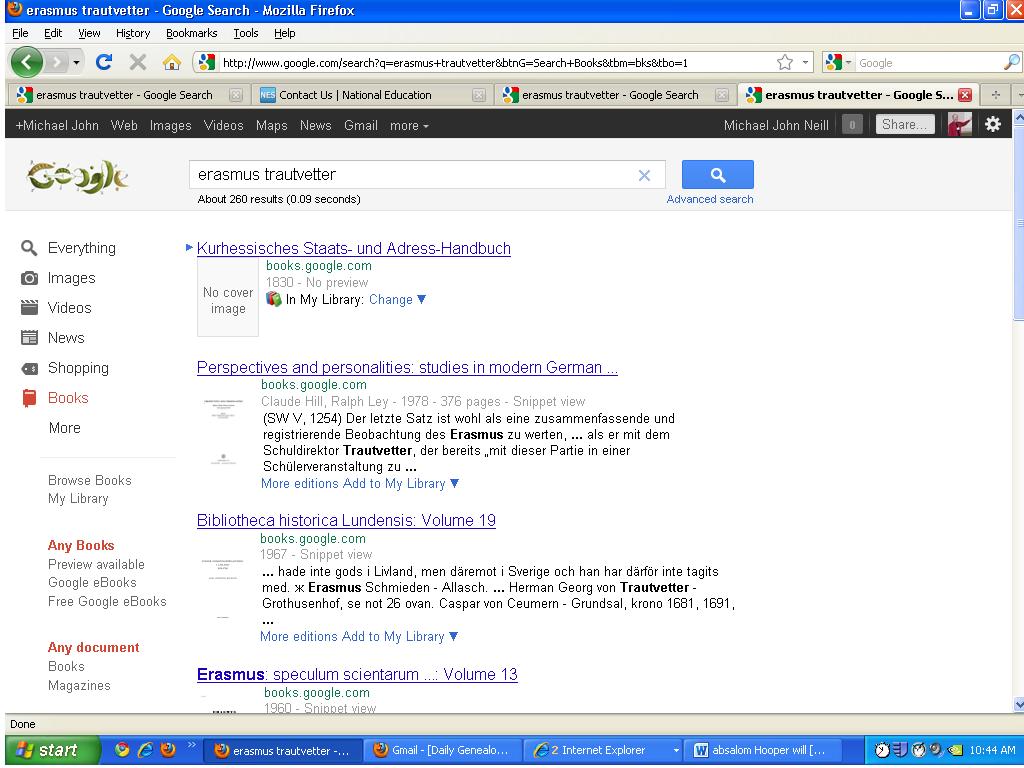
Finding the Book on Erasmus Trautvetter
I'm hoping to get someone to help me. According to a search of Google Books, this book has a reference to Erasmus Trautvetter. The book apparently is a German directory.
The book is not online and apparently there are few copies. A WorldCat reference indicated the book was only at Harvard University. The book won't interlibrary loan.
Is anyone able to make a copy of the page that contains the entry for Erasmus?
18 July 2011
Organize the Inconclusive with Discrepancy Charts
------------------------------------------------------------------------------------------------------------------------------
If the data genealogists collected always agreed and was always consistent, many professional genealogists would be out of business. So would a few authors. Discrepancies and inconsistencies are a matter of course in genealogical research, as is dealing with those inconsistencies.
In terms of consistency, genealogical data can fall into one of three categories:
- Entirely consistent, every document providing the same date and place for each event, with no conflict between sources (the ideal);
- Conflicting, but consistent enough to allow different researchers to reach the same conclusion;
- Entirely inconsistent and inconclusive.
In your research you may run into discrepancies such as ages listed in the census that do not correspond with ages obtained from other sources, birth dates in the family Bible that do not agree with the birth certificate, death dates on the tombstone that do not match the death certificate, and so on. There are many reasons for discrepancies. Sometimes you can determine the reason and explain the difference. Such is the case with birth or marriage dates "changed" in some records so that the first child did not come "too early." Different surnames for an individual may be due to a remarriage by a parent and not the result of dishonesty on the part of our ancestors or ineptitude on the part of clerks.
But often you will be unable to explain the difference and may never be able to say with a degree of certainty which date or location for an event is correct. There are cases where almost every document or record gives a different age or place of birth and determining which one is correct can be nearly impossible. The purpose of discrepancy charts is to summarize the conflicts between different record sources and to indicate the source for each conflicting piece of data. Using discrepancy charts will more easily allow you to weigh the evidence.
Sample Discrepancy Charts
The two samples below show how discrepancy charts can help organize any conflicting information that you may have.
Seeking Birth Information, Case 1
In the process of searching for my great-grandmother's (Ida SARGENT TRAUTVETTER MILLER) place of birth, I found several different birth localities. One locale did not appear on any of the other records and even Ida had listed different places of birth on each of her marriage applications. Some places had been listed more than once and I soon could not remember what document had provided what location. After a while, my confusion hindered my research efforts. While the localities were in close proximity to each other, there was no "preponderance" of evidence that allowed me to conclude which place was most likely.
There was no way that I could list the different places Ida was "born" on a pedigree chart or an ancestral chart (try listing five different locations for a birthplace!). So, in order to help me possibly discover the correct place, or to at least keep track of what each document said, I decided to make a list of all the different localities I had and indicate what sources had given those localities (and, if known, the informant on each of these records). In further research, I am using all of these localities (at least the ones that are specific) with the thought that maybe some of the places were residences of the family at some point in time. For Ida, the birth date of 1 April 1874 seems to be correct, since the majority of records either gave that date or do not significantly contradict it.
As you can see below, I used several columns for each record. Not all the sources provided all these pieces of information and in some cases I estimated her birth date from her age at the time the record was created. When I did this, I indicated that the birth date is estimated. You can see that some records provide both an age and a birth date. For the purposes of this article, some records have been omitted from the chart, citation information is not complete (although it is important), and the exact date of the event/record has not been included.
Record | Birth date | Birthplace | Age | Informant | Source Type |
|---|---|---|---|---|---|
| John TRAUTVETTER death certificate, 1937 | Not given | Alexandria, Missouri | Not given | Secondary | |
| Ida MILLER death certificate, 1939. | 1 April 1874 | Adams County, Illinois | 65 years, 2 months, and 22 days | Hospital Records | Secondary |
| Ida's Obituary, 1939 | 1 April 1874 | Warsaw, Hancock, Illinois | 65 years | Secondary | |
| Marriage to George TRAUTVETTER, 1898, Hancock County, Illinois | Ca. 1874/1875 (estimated from age) | Iowa | 23 years | Probably Ida | Secondary |
| Marriage to William MILLER, 1936, Hancock County, Illinois | Ca. 1873/1874 | Lima, Adams, Illinois | 63 years | Probably Ida | Secondary |
| 1880 Census, Hancock County, Illinois | Ca. 1873/1874 (estimated) | Iowa | 6 years | Secondary | |
| 1900 Census, Hancock County, Illinois | April 1874 | America | 26 years | Secondary |
Seeking Birth Information: Case 2
The second discrepancy chart is for Ida's father, Ira William SARGENT. In this case, the birthplace, while not overly specific, is at least consistent. Based upon the records used in the chart, a reasonable birth date estimate would be between 1840 and 1845.
Record | Birth date | Birthplace | Age | Informant | Source Type |
|---|---|---|---|---|---|
| Death Certificate, 1916 Peoria County, Illinois | Ca. 1840/1841 (estimated from age-birth date not stated on record) | Unknown | 75 years | Hospital records | Secondary |
| 1880 Census, Hancock County, Illinois | Ca. 1844/1845 (estimated from age) | Canada | 35 years | Secondary | |
| 1900 Census, Hancock County, Illinois | March 1843 | Canada F. | 57 years | Secondary | |
| 1910 Census, Peoria County, Illinois | Ca. 1841/1842 | Not listed | 68 years | Probably Hospital records | Secondary |
| 1883 Marriage to Martha PHELPS, Adams County, Illinois | Ca. 1842/1843 | Not listed | 40 years | Secondary | |
| Adams County, Illinois Poor House Records, August 1907 | Ca. 1844 | Canada | "about 63 years" | Secondary | |
| Insanity Case, Adams County, Illinois, September 1907 | Ca. 1843/1844 | Not listed | 63 years | Secondary | |
| Insanity Case, Adams County, Illinois, September 1905 | Ca. 1838/1839 | Canada | 66 years | Secondary |
The Role of Primary and Secondary Sources
While analyzing conflicting pieces of information, genealogists need to be aware of the differences between primary and secondary sources. A source is considered to be primary if it was an original record recorded close to the time when the event actually took place and the informant had a logical reason to know the information and was likely present at the event. A source that is not primary is considered secondary.
Classifying a source as primary or secondary does not comment about its accuracy. Secondary sources can be correct and primary sources can be wrong. However, more credence is placed in primary sources for an event, especially when there are two or more primary sources that corroborate each other.
In some cases, you may not be able to determine who provided the information and therefore not know for certain if it is a primary or secondary record. Some records have a place for informant, but many do not. Speculation about the informant may be necessary, but if you are speculating, you should indicate this by use of "probable," "possible," or some other similar word.
In the case of Ida SARGENT TRAUTVETTER MILLER, the sources all listed are secondary sources for her birth date and birthplace. This does not mean that they are wrong; however, in this case since they all provide different birthplaces, some of them are obviously incorrect. It should be remembered that in some cases, Ida might not have provided the information herself, or that the informant might have misunderstood the question.
Sources will not all agree, and one source can easily be incorrect. For this reason, genealogists need to access more than one record or source where possible and focus on primary sources where available. Unfortunately, there are times when primary sources are not available and genealogists are left using a number of secondary sources. There is no birth certificate for Ida, no baptismal record for Ida, and no Bible record that lists her date and place of birth (I'd love to hear about it if there is!). As one researches in the era before vital records, including secondary sources becomes necessary. For this reason, in this era, analyzing all possible records is even more important.
The discrepancy charts here have focused on dates and locations, but maiden names, and names of parents also disagree. Similar charts could easily be compiled for these facts as well. Again, classifying each source as primary or secondary is an integral part of the chart.
One Last Important Note
You should never change a source to correct it. If you are fortunate enough to determine the cause of the discrepancy, or at least be able to explain it, indicate that in your notes. My grandmother believed she was born in Tioga, Hancock, Illinois. Her marriage record, application for a social security number, death certificate, and obituary all list this birthplace. However, she was not born in Tioga. She was born several miles east of Tioga in a town called Elderville. Her birth certificate and baptismal record indicate she was born in Elderville. Additionally, her parents are listed with an Elderville address in the 1910 Census, a few months before her birth in September of 1910. The sources where Grandma listed her birthplace are secondary sources. Her birth certificate and baptismal record are primary sources. The census record doesn't prove her birthplace, but lends credence to it being in the Elderville area. Grandma always insisted to me she was born in Tioga.
Grandma's belief regarding her birthplace should be recorded in with my notes, either on her family group chart or in her record in my genealogy software program. There are programs that allow you to enter multiple places and dates for an event. Take advantage of this capability. Tracking these different sources and their differing pieces of data is an important part of the research process.
This originally appeared on Genealogy.com
17 July 2011
My Wife's 16 great-great-grand's Pie Chart
Four Generations of 4H
The first picture in this post was the 1933 4H steer of John Ufkes, my grandfather. This is the only livestock picture I have of Granddad's. It most likely was taken at his parents' farm east of Basco, Hancock County, Illinois. Looks to me like this is a shorthorn, but I could be wrong. Granddad always raised Hereford cattle, but 1933 is a little before my time and I'm not certain what great-grandfather Ufkes raised.
The second picture is my Dad, Keith Neill, with one of his livestock projects, probably in the 1950s. I don't think this was taken at the fair--it looks like the west barn, but I'm not certain. It would have been an Angus calf--there was no other breed for Grandpa Neill.

This is me taken at the 4H fairgrounds near Carthage, Hancock County, Illinois. Probably taken in the late 1970s. It may be difficult to see what is on the hat, but it's a picture of an Angus cow, bull, steer, or heifer. I can't quite see what's on my feet, but I know I'm not wearing tennis shoes.
16 July 2011
My 16 great-great-grandparents
- 1/8 Ireland
- 1/16 Ohio
- 1/16 Indiana
- 1/16 Canada
- 1/16 Thuringen
- 1/16 Unknown
- 3/16 Illinois
- 3/8 Ostfriesland

- 3/4 Hancock County, Illinois
- 1/8 Adams County, Illinois
- 1/16 Peoria County, Illinois
- 1/16 Unknown
15 July 2011
A Fruit Fully Ripened for Eternity
Thursday, January 24, 1878
Page: 4

This is the short obituary for Keziah Elliott Holden who died in Adams County, Illinois, in 1878. The last sentence struck me as slightly unusual, ending with she "passed away like a fruit fully ripened for eternity." One just has to love obituaries with phrases like that.
Keziah's son Daniel P. Holden's step-daughter likely married Montivelli Harness, the adopted son of my ancestors James and Elizabeth Rampley, in the 1880s in Adams County, Illinois. Keziah and James Rampley were first cousins. The step-daughter likely died sometime between her marriage and Montivelli's apparent re-marriage in Oklahoma in the early 1900s.
Montivelli's life is not too well documented and we're working on an update on him for an upcoming issue of Casefile Clues.
14 July 2011
Monteville Marries in the 1880s


There's a reason genealogists are told to utilize as many sources as possible and to get to the original when they can.