Michael John Neill's genealogy website. Things that cross my path, general research suggestions, and whatever else ...with a little bit of attitude. I don't post "news" just to post it, never post a press release (edited or otherwise), don't feign excitement, and pretty much say what I think.
22 July 2011
Ancestry.com--Let's Get Better Source Descriptions
20 July 2011
The Old Ancestry.com Search
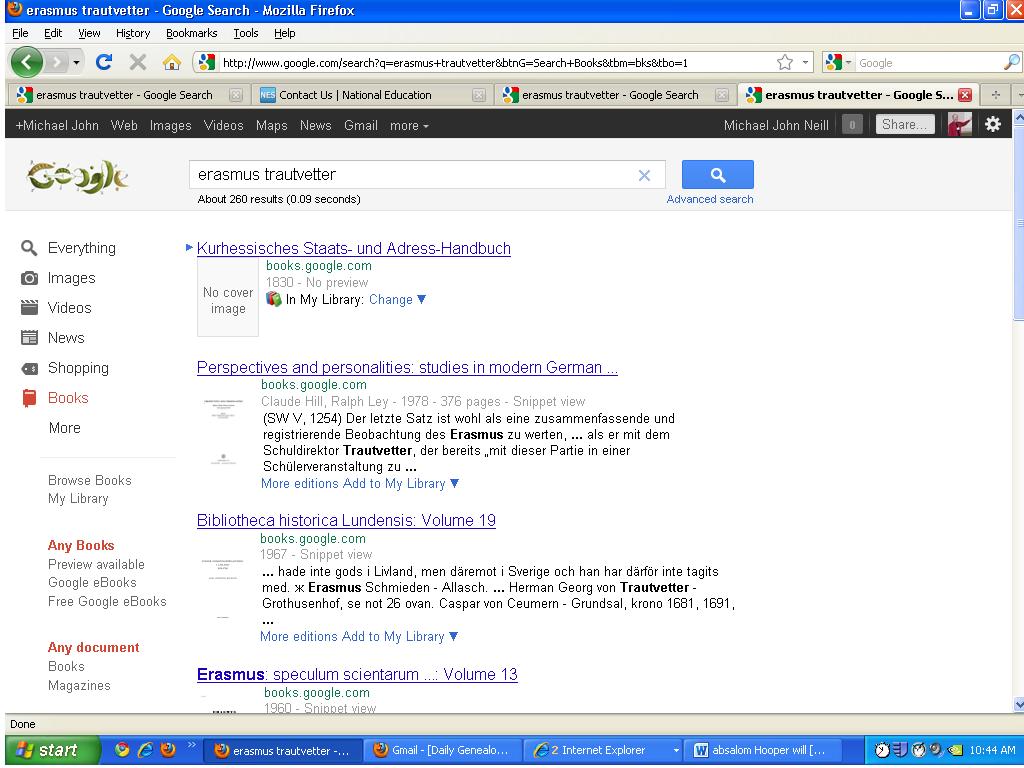
Finding the Book on Erasmus Trautvetter
I'm hoping to get someone to help me. According to a search of Google Books, this book has a reference to Erasmus Trautvetter. The book apparently is a German directory.
The book is not online and apparently there are few copies. A WorldCat reference indicated the book was only at Harvard University. The book won't interlibrary loan.
Is anyone able to make a copy of the page that contains the entry for Erasmus?
18 July 2011
Organize the Inconclusive with Discrepancy Charts
------------------------------------------------------------------------------------------------------------------------------
If the data genealogists collected always agreed and was always consistent, many professional genealogists would be out of business. So would a few authors. Discrepancies and inconsistencies are a matter of course in genealogical research, as is dealing with those inconsistencies.
In terms of consistency, genealogical data can fall into one of three categories:
- Entirely consistent, every document providing the same date and place for each event, with no conflict between sources (the ideal);
- Conflicting, but consistent enough to allow different researchers to reach the same conclusion;
- Entirely inconsistent and inconclusive.
In your research you may run into discrepancies such as ages listed in the census that do not correspond with ages obtained from other sources, birth dates in the family Bible that do not agree with the birth certificate, death dates on the tombstone that do not match the death certificate, and so on. There are many reasons for discrepancies. Sometimes you can determine the reason and explain the difference. Such is the case with birth or marriage dates "changed" in some records so that the first child did not come "too early." Different surnames for an individual may be due to a remarriage by a parent and not the result of dishonesty on the part of our ancestors or ineptitude on the part of clerks.
But often you will be unable to explain the difference and may never be able to say with a degree of certainty which date or location for an event is correct. There are cases where almost every document or record gives a different age or place of birth and determining which one is correct can be nearly impossible. The purpose of discrepancy charts is to summarize the conflicts between different record sources and to indicate the source for each conflicting piece of data. Using discrepancy charts will more easily allow you to weigh the evidence.
Sample Discrepancy Charts
The two samples below show how discrepancy charts can help organize any conflicting information that you may have.
Seeking Birth Information, Case 1
In the process of searching for my great-grandmother's (Ida SARGENT TRAUTVETTER MILLER) place of birth, I found several different birth localities. One locale did not appear on any of the other records and even Ida had listed different places of birth on each of her marriage applications. Some places had been listed more than once and I soon could not remember what document had provided what location. After a while, my confusion hindered my research efforts. While the localities were in close proximity to each other, there was no "preponderance" of evidence that allowed me to conclude which place was most likely.
There was no way that I could list the different places Ida was "born" on a pedigree chart or an ancestral chart (try listing five different locations for a birthplace!). So, in order to help me possibly discover the correct place, or to at least keep track of what each document said, I decided to make a list of all the different localities I had and indicate what sources had given those localities (and, if known, the informant on each of these records). In further research, I am using all of these localities (at least the ones that are specific) with the thought that maybe some of the places were residences of the family at some point in time. For Ida, the birth date of 1 April 1874 seems to be correct, since the majority of records either gave that date or do not significantly contradict it.
As you can see below, I used several columns for each record. Not all the sources provided all these pieces of information and in some cases I estimated her birth date from her age at the time the record was created. When I did this, I indicated that the birth date is estimated. You can see that some records provide both an age and a birth date. For the purposes of this article, some records have been omitted from the chart, citation information is not complete (although it is important), and the exact date of the event/record has not been included.
Record | Birth date | Birthplace | Age | Informant | Source Type |
|---|---|---|---|---|---|
| John TRAUTVETTER death certificate, 1937 | Not given | Alexandria, Missouri | Not given | Secondary | |
| Ida MILLER death certificate, 1939. | 1 April 1874 | Adams County, Illinois | 65 years, 2 months, and 22 days | Hospital Records | Secondary |
| Ida's Obituary, 1939 | 1 April 1874 | Warsaw, Hancock, Illinois | 65 years | Secondary | |
| Marriage to George TRAUTVETTER, 1898, Hancock County, Illinois | Ca. 1874/1875 (estimated from age) | Iowa | 23 years | Probably Ida | Secondary |
| Marriage to William MILLER, 1936, Hancock County, Illinois | Ca. 1873/1874 | Lima, Adams, Illinois | 63 years | Probably Ida | Secondary |
| 1880 Census, Hancock County, Illinois | Ca. 1873/1874 (estimated) | Iowa | 6 years | Secondary | |
| 1900 Census, Hancock County, Illinois | April 1874 | America | 26 years | Secondary |
Seeking Birth Information: Case 2
The second discrepancy chart is for Ida's father, Ira William SARGENT. In this case, the birthplace, while not overly specific, is at least consistent. Based upon the records used in the chart, a reasonable birth date estimate would be between 1840 and 1845.
Record | Birth date | Birthplace | Age | Informant | Source Type |
|---|---|---|---|---|---|
| Death Certificate, 1916 Peoria County, Illinois | Ca. 1840/1841 (estimated from age-birth date not stated on record) | Unknown | 75 years | Hospital records | Secondary |
| 1880 Census, Hancock County, Illinois | Ca. 1844/1845 (estimated from age) | Canada | 35 years | Secondary | |
| 1900 Census, Hancock County, Illinois | March 1843 | Canada F. | 57 years | Secondary | |
| 1910 Census, Peoria County, Illinois | Ca. 1841/1842 | Not listed | 68 years | Probably Hospital records | Secondary |
| 1883 Marriage to Martha PHELPS, Adams County, Illinois | Ca. 1842/1843 | Not listed | 40 years | Secondary | |
| Adams County, Illinois Poor House Records, August 1907 | Ca. 1844 | Canada | "about 63 years" | Secondary | |
| Insanity Case, Adams County, Illinois, September 1907 | Ca. 1843/1844 | Not listed | 63 years | Secondary | |
| Insanity Case, Adams County, Illinois, September 1905 | Ca. 1838/1839 | Canada | 66 years | Secondary |
The Role of Primary and Secondary Sources
While analyzing conflicting pieces of information, genealogists need to be aware of the differences between primary and secondary sources. A source is considered to be primary if it was an original record recorded close to the time when the event actually took place and the informant had a logical reason to know the information and was likely present at the event. A source that is not primary is considered secondary.
Classifying a source as primary or secondary does not comment about its accuracy. Secondary sources can be correct and primary sources can be wrong. However, more credence is placed in primary sources for an event, especially when there are two or more primary sources that corroborate each other.
In some cases, you may not be able to determine who provided the information and therefore not know for certain if it is a primary or secondary record. Some records have a place for informant, but many do not. Speculation about the informant may be necessary, but if you are speculating, you should indicate this by use of "probable," "possible," or some other similar word.
In the case of Ida SARGENT TRAUTVETTER MILLER, the sources all listed are secondary sources for her birth date and birthplace. This does not mean that they are wrong; however, in this case since they all provide different birthplaces, some of them are obviously incorrect. It should be remembered that in some cases, Ida might not have provided the information herself, or that the informant might have misunderstood the question.
Sources will not all agree, and one source can easily be incorrect. For this reason, genealogists need to access more than one record or source where possible and focus on primary sources where available. Unfortunately, there are times when primary sources are not available and genealogists are left using a number of secondary sources. There is no birth certificate for Ida, no baptismal record for Ida, and no Bible record that lists her date and place of birth (I'd love to hear about it if there is!). As one researches in the era before vital records, including secondary sources becomes necessary. For this reason, in this era, analyzing all possible records is even more important.
The discrepancy charts here have focused on dates and locations, but maiden names, and names of parents also disagree. Similar charts could easily be compiled for these facts as well. Again, classifying each source as primary or secondary is an integral part of the chart.
One Last Important Note
You should never change a source to correct it. If you are fortunate enough to determine the cause of the discrepancy, or at least be able to explain it, indicate that in your notes. My grandmother believed she was born in Tioga, Hancock, Illinois. Her marriage record, application for a social security number, death certificate, and obituary all list this birthplace. However, she was not born in Tioga. She was born several miles east of Tioga in a town called Elderville. Her birth certificate and baptismal record indicate she was born in Elderville. Additionally, her parents are listed with an Elderville address in the 1910 Census, a few months before her birth in September of 1910. The sources where Grandma listed her birthplace are secondary sources. Her birth certificate and baptismal record are primary sources. The census record doesn't prove her birthplace, but lends credence to it being in the Elderville area. Grandma always insisted to me she was born in Tioga.
Grandma's belief regarding her birthplace should be recorded in with my notes, either on her family group chart or in her record in my genealogy software program. There are programs that allow you to enter multiple places and dates for an event. Take advantage of this capability. Tracking these different sources and their differing pieces of data is an important part of the research process.
This originally appeared on Genealogy.com
17 July 2011
My Wife's 16 great-great-grand's Pie Chart
Four Generations of 4H
The first picture in this post was the 1933 4H steer of John Ufkes, my grandfather. This is the only livestock picture I have of Granddad's. It most likely was taken at his parents' farm east of Basco, Hancock County, Illinois. Looks to me like this is a shorthorn, but I could be wrong. Granddad always raised Hereford cattle, but 1933 is a little before my time and I'm not certain what great-grandfather Ufkes raised.
The second picture is my Dad, Keith Neill, with one of his livestock projects, probably in the 1950s. I don't think this was taken at the fair--it looks like the west barn, but I'm not certain. It would have been an Angus calf--there was no other breed for Grandpa Neill.

This is me taken at the 4H fairgrounds near Carthage, Hancock County, Illinois. Probably taken in the late 1970s. It may be difficult to see what is on the hat, but it's a picture of an Angus cow, bull, steer, or heifer. I can't quite see what's on my feet, but I know I'm not wearing tennis shoes.
16 July 2011
My 16 great-great-grandparents
- 1/8 Ireland
- 1/16 Ohio
- 1/16 Indiana
- 1/16 Canada
- 1/16 Thuringen
- 1/16 Unknown
- 3/16 Illinois
- 3/8 Ostfriesland

- 3/4 Hancock County, Illinois
- 1/8 Adams County, Illinois
- 1/16 Peoria County, Illinois
- 1/16 Unknown
15 July 2011
A Fruit Fully Ripened for Eternity
Thursday, January 24, 1878
Page: 4

This is the short obituary for Keziah Elliott Holden who died in Adams County, Illinois, in 1878. The last sentence struck me as slightly unusual, ending with she "passed away like a fruit fully ripened for eternity." One just has to love obituaries with phrases like that.
Keziah's son Daniel P. Holden's step-daughter likely married Montivelli Harness, the adopted son of my ancestors James and Elizabeth Rampley, in the 1880s in Adams County, Illinois. Keziah and James Rampley were first cousins. The step-daughter likely died sometime between her marriage and Montivelli's apparent re-marriage in Oklahoma in the early 1900s.
Montivelli's life is not too well documented and we're working on an update on him for an upcoming issue of Casefile Clues.
14 July 2011
Monteville Marries in the 1880s


There's a reason genealogists are told to utilize as many sources as possible and to get to the original when they can.
Is Casefile Clues the Answer to Your Tight Genealogy Budget?
12 July 2011
Ancestry.com Stock
08 July 2011
Who Susannah Rucker Was Not
However, her maiden name was not Phillips.
07 July 2011
Percents and Genealogy
04 July 2011
Organizing Data
Organizing Data
From the Ancestry Daily News 18 June 2003
This week we start with a quote not from a genealogist but from a mathematician."A great discovery solves a great problem but there is a grain of discovery in the solution of any problem. Your problem may be modest; but if it challenges your curiosity and brings into play your inventive facilities, and you solve it by your own means, you may experience the tension and enjoy the triumph of discovery."
—George Polya
Sounds like genealogy, doesn't it? While Polya was a mathematician, he is better known for his problem solving approach than anything else. And isn't genealogy problem solving? In fact, each genealogist has his or her own problem to solve.
Polya reasoned that there were four steps to the problem solving process:
Personally, I think understanding the problem completely is the most important part of the process. One excellent way to understand any problem better is to organize the information we already have. This week we look at a partial list of ways to organize genealogical information. Our discussion is not meant to be comprehensive, but rather our intent is to illustrate some ways genealogical facts can be put together, all the while hoping to notice something we did not notice before. Some of these techniques are old standards in "genealogy land" and some are not.
Family Group Charts
A family group chart contains basic genealogical information on one couple and their children and is undoubtedly one of the most popular genealogical forms used today. The form provides a research framework for searching the entire family, which is an excellent genealogical strategy. Blank copies of these charts are also excellent to pass around at the family reunion for relatives to complete. A downloadable family group chart is available at the Ancestry.com site at: www.ancestry.com/save/charts/familysheet.htm Most genealogists started out with family group charts, and these charts continue to serve an excellent purpose throughout our research.
Pedigree Charts
This chart typically outlines four or more generations of one person's ancestry, listing at least the parents, grandparents, and great-grandparents, and is another very popular form. Often the purpose of this chart is to provide a skeleton of one person's ancestry. A downloadable pedigree chart is available at: www.ancestry.com/save/charts/ancchart.htm.
Discrepancy Charts
This is one of my favorite types of charts, probably because I have so many confusing ancestors. This chart organizes conflicting dates or places for one specific event in a person's life. My great-grandmother was supposedly born in five different places and charting this information made it easier for me to keep track of what record provided what place of birth. I find it helpful to list all various dates for an event along with where that specific information was obtained and who was the likely informant on that record. This summary helps me to compare all the information and determine as best I can which date or location is most likely to be correct. An article discussing discrepancy charts and two specific examples can be viewed at: www.genealogy.com/37_neill.html.
Acquaintance Sheets
For certain time periods and areas, tracking an ancestor's acquaintances is an important part of the research process. Have you ever encountered the name of a witness on a relative's document and been sure that you have seen that name somewhere else before? Tracking the individuals who were somehow involved in your ancestor's life may help you determine where the ancestor was from, to whom he was related, or where he later went. Deeds, wills, bonds, and other records frequently have names of other individuals as witnesses, neighbors, or bondsmen. If the same names appear with your ancestor in Kentucky and in Virginia, there may be a relatively strong connection. A sample of an acquaintance sheet is viewable here:www.rootdig.com/acquaintance.html.
Chronologies
Working an ancestor out from birth to death (including everything in between) is an excellent way to organize information and notice gaps and oversights in your research. Regular readers of the "Ancestry Daily News" are familiar with this approach as several of us have written about it before, largely because we know that chronologies are an extremely valuable genealogical tool and can be used in several different situations.
Geographic Organization
Maps are essential to family history research. Mapping out all those locations in an ancestor's life may help you to see geographic areas that have been overlooked in your research. It may also help you to gain a better perspective on an ancestor's life. Maps organize information geographically; this is something that cannot always be done easily with only text. Things that appear inconsistent may not appear as inconsistent when viewed on a map. The different places of birth for my great-grandmother are in four towns in three states. However when viewed on a map all these locations are in close proximity to each other and are not as different as they appear on the surface. A picture truly is worth a thousand words. And a map may prevent you from wasting many hours of research time.
Let Your Software Do the Work
One of my favorite things to do with my genealogical software package is to have it give me a listing of all the individuals in my database who match a certain criteria. I do more with this than just see who is born on the same day as I am. These kinds of reports are especially useful when preparing for research trips or using certain records. Can your software print out a list of everyone in your database born in a certain village, sorted by date of birth? Many programs do, and such reports are especially helpful when using records that are organized chronologically. I insert extra lines between each entry on the report and have a custom-made research log for use at the research facility. This saves me time and helps me to look for everyone in the record that I want. It sure beats flipping through hundreds of family group charts to see who was born in which village. There's an example of a sorted list at:www.rootdig.com/focuslist.html
Other Techniques?
There are other organizational techniques that researchers can also employ. Reorganizing information can help us to notice gaps and inconsistencies in our research—and hopefully make us aware of clues we have overlooked. Think about the number of ways a child can "arrange" five building blocks. Putting the five single blocks in a horizontal row or a in a vertical column does not change each individual block and yet the appearance of the configuration is different. There are many other stacking arrangements that can be made without changing each block. Think of your data as blocks that can be stacked or organized in different ways. What you see depends upon how you organize what you have. Just remember, that one big pile on your desk usually does not count!
---------------------------
This article originally appeared in the Ancestry Daily News on 18 June 2003. We are posting old articles here on the Rootdig.com blog as time allows.
Problem Solving
Problem Solving
From the Ancestry Daily News 11 May 2005
As a math professor, I am always asked what mathematics has to do with genealogy. Plenty. Besides my personal favorite of land platting, the analytical and logical skills one gains from mathematics come in extremely handy when solving genealogical problems. This week we look at one mathematician's framework for handling problems and see how it can relate to family history problems as well.
George Polya was a Hungarian born mathematician who advocated the use of a general problem solving strategy. While his work was focused on mathematical dilemmas, family historians can benefit from applying this same strategy as well. When you have no strategy, the brick walls rarely come tumbling down.
Polya's strategy had four basic steps:
- Understanding the Problem
- Devising a Plan
- Carrying out the Plan
- Looking Back
This week we will look at these steps one by one.
Understanding the Problem
Understanding the problem is not as simple as it sounds, but it is an excellent place to start. I have always believed this stage to be the most important in the entire problem-solving process. Generally the problem should be specifically stated and purposely focused, such as:
- What was Noentje Ufkes' maiden name?
- When were James Rampley and Elizabeth Chaney married?
- Where is Samuel Neill enumerated in the 1880 census?
- How did Thomas Galloway acquire his property in Baltimore County, Maryland?
Well-defined problems should focus on a person, a place, and an event.
Then there are problems such as:
- I want to know all I can about Noentje.
- I want to completely research James and Elizabeth this afternoon.
These problems are not specific. The statements are too vague and either unrealistic or need to be broken down into smaller, more manageable pieces. Learning "everything" about one family or couple may be possible over the long term; rarely is it possible in an afternoon. One or two records will not reveal a relative's "whole story." Information gleaned from records must be accurately interwoven with about the history, culture, and lifestyle of the area and era in which the person lived. This takes time. Most successful researchers begin with a specific goal.
Understanding the problem is more than simply stating the research goal precisely. There are many things that should be learned about if the researcher is not already familiar with them. These items include:
- The records (both public and private) that were created during the time period under study.
- The culture in which the person or persons lived.
- The socioeconomic status of the individuals under study.
- Groups that the problem person was associated with (Ethnic, religious, etc.).
- The methodology appropriate for the time period, region, and individuals under study.
- Words from the native language necessary to perform research in foreign language records.
One place to start learning about the records applicable to any problem is to read the Family History Library's research guide (www.familysearch.org) to the areas under study. Those researching problems in the United States can also refer to the appropriate section of Red Book (published by Ancestry) for information on local and state records. Both the Red Book and the Family History Library research guides contain references to additional reference materials, including foreign language word lists where appropriate.
Local and regional histories are also suggested reading material for additional background information. Even "non-genealogy" books may provide a background not gained elsewhere. Historical studies, dissertations, and papers published in academic journals may provide entirely new insight into your ancestors and their problems, positively impacting your research. As an example, Prairie Patrimony (Sonya Salamon, University of North Carolina Press, 1995) discusses agricultural inheritance patterns in the upper Midwest. It confirmed things I had already surmised from personal experience and in researching many families from one of the ethnic groups discussed in the book. Salamon also helped to explain things I did not quite understand and confirmed trends I had noticed. The more you know, the better prepared you will be to solve your problem. Material written by a non-genealogist occasionally brings a fresh perspective.
If your problem involves the interpretation of a document, make certain you understand the language and the terminology being used during the time period. Sometimes completely typing a document or even reading it out loud will cause you to notice a detail or an interpretation that had been overlooked. It may be necessary to have someone else look at the document with a fresh, unbiased perspective.
Learning about the methodology appropriate for the area is crucial. One way to do this is to read journal articles for the area under study. If a subscription is out of the question, determine if any nearby libraries subscribe to genealogical journals applicable to your area of interest. Many will contain case studies where other family problems have been solved. The National Genealogical Society Quarterly and the American Genealogist are two national magazines that contain excellent well-written case studies. There are a variety of state publications as well, usually published by a state genealogical society. There are also a variety of publications focusing on various ethnic groups, which usually present their own unique problems.
Devising a Plan
Planning usually involves determining what records are most likely to provide the desired information. In other situations, it will be necessary to analyze a series of documents to see if a generally consistent conclusion is indicated. This is why learning about the records is extremely important, especially when researching in a "new" state. What was true about records in Illinois in 1880 is not necessarily true about records in Virginia in 1780. Of course, the plan should always be to locate as many records as possible given that one individual record may be incorrect or inconclusive.
The plan may be simple or complex, depending upon the situation, but it should be fairly specific:
- Order a marriage index from the Family History Library.
- Write a letter to the church secretary.
- Search for the family in the census.
- Hire a researcher.
Writing down your plan is also necessary so that research efforts can be tracked. Polya suggested math students look at similar problems. Genealogical educators would suggest looking at case studies written about similar families in the same area and time period. What helped one person solve their problem may help you solve yours.
Carrying Out the Plan
This is the easiest part of the plan. Do it. And track it. You do not want to do the same thing again (unless you realize your previous attempt was flawed, utilized an incomplete database, etc.)
Looking Back
Occasionally the plan will succeed. The record will be located. The question will be answered. Of course, getting one answer to a genealogy question usually means that there are more unanswered questions. And so we go back to step one.
And when our question is not answered, we also return to step one. Perhaps there was something we overlooked, a record we did not understand, an assumption we should not have made, a term we misinterpreted, a name we overlooked, a spelling we did not consider.
Next week we will take a look at some genealogy problems viewed through this set of steps. There are other ways to organize and solve genealogy problems to be certain. Failing to organize your research can easily add to your confusion and may even create brick walls where none existed.
--------------------
This article originally appeared in the Ancestry Daily News on 11 May 2005. We are posting old articles here on the Rootdig.com blog.Problem Solving: An Example--
Problem Solving: An Example
From the Ancestry Daily News 18 May 2005
Thanks to all who sent me additional problem solving strategies based upon last week's column.
The key, as several pointed out, is that methodical and reasoned research is preferable to research that is unfocused and unorganized. This week we look at an example in light of the framework discussed last week.
Louise Mortier
Louise was born in Belgium in the 1850s and immigrated with her husband and one child in 1880. Our long-term project is to research her ancestry as completely as possible. Realizing that such a goal may never be achieved in one lifetime, my initial problem is to find a record of her christening or her birth. Such a document would provide the names of her parents and the date and place of her birth. With the goal now simply stated, we continue in our attempt to understand the problem as completely as possible.
Understand the Problem
Using research guides on the Family History Library website (www.familysearch.org), the Belgium Roots Project at RootsWeb (http://belgium.rootsweb.com), and the CarPark Introduction to Dutch and Belgian Genealogy Page (www.rabbel.info), I obtained some good background information. Based upon these guides it was apparent that there are records of births and christenings for the time period I need. However the use of these resources requires knowledge of the specific place of birth, which I do not have. My attempt to locate a christening record is put on hold while I work on my new problem: locating the village of birth.
This is still a specific problem. However, my search needs to remain focused in the United States, and I will need to use records created after Louise immigrated, documents I can probably locate using information I already have. Initially settling in Rock Island County, Illinois, in 1880, the family spent a few years across the Mississippi River in Scott County, Iowa, before returning to Illinois. Fortunately, Louise did not move much after her immigration. That will make this search easier.
This problem (and its solution) reinforces the importance of researching the more recent information on a person and working back in time, even when the real goal is to use earlier records and locate earlier generations. Researching a person‘s life from the end to the beginning is usually the best approach.
Sources that might provide Louise's place of birth include:
- Her death certificate
- Church records
- Her obituary
- Death records on her children
- Family sources
The location of each of these records is a problem in and of itself. But that is the great thing about having a focused problem (locating her place of birth). It allows you to brainstorm for all the possible sources that might contain the desired information. I need to think, â€Å“What document could contain the name of that village?â€
One Search at a Time
Given when Louise died, there are two paper copies of her death certificate: one at the county in which she died and one at the state department of vital records. While each record should contain the same information, one may be easier to access or cheaper to obtain than another. There may even be additional ways to access the records, such as microfilm copies in alternate locations. In this case, the records from the state office have been reproduced on film and are available through a personal visit to the Illinois State Archives or via loan to my local Family History Center. Again, learning about the records indicates that I have several options.
Records from Louise's church may also indicate information about her origin. A mention of her death or funeral is the most likely item to mention her birthplace, but other types of church records may provide similar information. Some denominations may include in their records where members were baptized or confirmed. Such a location would obviously be helpful for Louise.
Louise's obituary may also provide information on her origin. It is imperative to think about every newspaper that might have carried such a notice. There were several newspapers in the Rock Island area that should be searched. Morning and the evening editions should be referenced if appropriate. Rock Island also had a large Belgian ethnic community and the potential for a Flemish language newspaper should also be considered.
I may even need to go beyond Louise's death to locate her place of birth. The death records for Louise's children may also provide information on her origin as well. All of Louise's children died during a time when the death record has a space for place of birth of parent. The record may simply say â€Å“Belgium†but there is always the chance that it says something more. I will not know until I look.
There Are Other Sources as Well
The listing of items mentioned here is not complete. They are the sources I would search for first based upon the time period, the location, the denomination, and the ethnic origin of the focus person. Different times, different places, and different people will call for different solutions. This is one reason why reading and studying case studies of similar problems is vital for the genealogist. How someone else solved another problem may provide you with the clues to solve your own.
Some Records Might Not Help
While every extant record should be included in a comprehensive research plan, there are some records that are probably not going to provide the desired information.
Naturalization records are not likely to be helpful in this situation. Given the era, Louise was not naturalized in her own right and her husband's pre-1907 naturalization reveals little information on his origins and none on hers. The family's appearance on a ship manifest, located initially through the Immigrant Ship Transcriber's Guild (www.immigrantships.net) and later confirmed by accessing the actual manifest, also provide no specific clues as to the family's origins.
Devising the Plan
So far, we have just worked to understand our problem. This is always the first and most detailed step. We continue the process. For each source, I will determine how that source will be accessed.
Carrying Out the Plan
The source will be searched and the search and the search results will be recorded.
Going Back
With every completed search, I will:
- Compare what I have found with what I already had located.
- Learn more about the records if necessary.
- Check my assumptions.
In a future column, we'll see what record provided the missing place of birth and look at problems where the location of such information requires even more analysis and problem solving.
This article originally appeared in the Ancestry Daily News on 18 May 2005. We are posting old articles here on the Rootdig.com blog.
03 July 2011
July 4th Offer on Casefile Clues
- John Tinsley, of Amherst County, Virginia, died 1817
- Isaac Rucker, of Amherst County, Virginia , died 1790s
- James Rampley, of Harford County, Maryland, died 1817
- Volume 2-Number 20--Just One Wife Who Shaves Her Age. Records hinted that a man might have had more than one wife. Despite age discrepancies and first name variations, we've likely proven that there was just one wife.
- Volume 2-Number 21--1930 Census: Primary, Secondary, Original, Derivative, Direct and Indirect. You'll never look at a census entry the same way again-also shows how in this case, New York became Kentucky
- Volume 2-Number 22--Finding the Biegers in 1850. Organizing our search and our negative search results in an attempt to find a German immigrant living in Cincinnati in 1850.
- Volume 2-Number 23--Separating Two George Butlers--working on two men born in Michigan in the same year with a father of the same name.
- Volume 2-Number 24-A Minor Naturalization
- Volume 2-Number 25-Genealogical Potpourri
- Volume 2-Number 26-Looking for Benjamin-Formulating a Census Search
- Volume 2-Number 27-An 1849 Cash Land Sale
- Volume 2-Number 28-From 1820-1870 Analyzing Enoch Tinsley's Census Entries
- Volume 2-Number 29-Middle Name Issues: Finding Henry J. Fecht in 1870 and Passenger Lists
- Volume 2-Number 30-The Master Reports--An Assignment of Homestead and Dower in the 1890s
- Volume 2-Number 31-The Parents Sell 10 Acres-an 1880 era land transaction
- Volume 2-Number 32-Clues from a Pig Murder--an 1820 era Kentucky Court Case
- Volume 2-Number 33-Civil War Pension Application-Why My Name's Different
- Volume 2-Number 34-Staying Focused on Divorces and a German Immigrant
- Volume 2-Number 35-Strategies for a 1820 New York Birth
- Volume 2-Number 36-First Appearing in an 1847 Marriage
- Volume 2-Number 37-The Chattel Property Will from Maryland
- Volume 2-Number 38-6 Marriages, Four Divorces, and Naming All My Siblings-a Civil War Pension File
- Volume 2-Number 39-A Guardianship from 1870s Documents "of age" children.
- Volume 2-Number 40-Moving Mother's Inheritance-18th century women's property rights discussion
23 June 2011
My Ancestor’s John Hancock
(originally published in the Ancestry Daily News on 16 November 2005)
Whether he signed with a flourish, scribbled out a scrawl, or literally made his mark, seeing your ancestor’s “signature” provides a different perspective especially when pictures and images are not available. This week we look at some places where you might find traces of your ancestor’s handwriting among the records.
Wills
If your relative left a last will and testament, the original document may have been filed for record along with other loose papers. These materials are usually grouped together in a packet or case file. The actual will should contain your ancestor’s signature (or at least his mark). In some areas, the will record is actually a transcription of the will which unfortunately also contains a transcription of your ancestor’s signature. If the handwriting of the will looks an awful lot like your ancestor’s “signature,” then you are probably reading a transcription of the will.
Estate Records
In 1861, Melinda Newman relinquished her right to administer the estate of her deceased husband. She signed the document. Another paper from the estate file contains the signatures of several of her children who were acting as either administrators of the estate or bondsmen. Receipts and other documents in the file could contain signatures of heirs or others with an involvement in the estate.
Court Records
Was your ancestor involved in a court case? If so did he sign any of the documents in the case file? Early court records usually consist of transcriptions of various records, but later materials should contain the actual papers filed while the case was active. If the legal action dragged on over several years, you may find numerous copies of your ancestor’s signature.
Petitions
Did your ancestor sign any petitions? State, regional, or local archives may have copies of various petitions, such as ones to build a new road, establish a new county, remove a county official, etc. The difficulty is that many of these records are unindexed and locating them requires diligence. My own ancestor signed a Maryland petition during the Revolutionary War protesting the selling of real estate by the colonial government. The property being sold was owned by a British subject and rented by my ancestor.
Marriage Records
Your ancestor’s marriage record may contain his signature, if the record is relatively recent (early records frequently just list names and dates). If your ancestor served as a bondsman on his relative’s marriage bond his signature as bondsman should be included. If your ancestor gave consent for a child to marry, the consent may be simply noted as “parental consent” without even a name specified. If you are lucky, the parent’s signature has been scrawled on the record. Consider marriages your ancestor could have witnessed as well. My own ancestor’s 1907 marriage contains a sibling of the groom and a sibling of the bride as witnesses. Both signed the marriage license.
Note Holder
Did your ancestor loan money to someone else? If the loan was secured by real estate, a mortgage should have been recorded in the jurisdiction where the property was located. A release of mortgage may have been recorded when the debt was paid, filed in a separate series of documents or perhaps recorded right on the mortgage copy itself. The transcriptions recorded separately likely do not contain your ancestor’s signature, but the notation made on the copy might. In this case, the clerk writes a note in the margin of the recorded mortgage indicating that it has been paid. The holder of the note signs under the clerk’s note, right in the record book indicating that the property is now free and clear. Antje Fecht signed such a release on a mortgage to her son-in-law in Illinois in the 1890s. It was a great place for me to get my third great-grandmother’s signature.
Pension Records
If your ancestor filed for a pension, there’s a good chance his signature is on one of the application papers. In some cases, there may be many copies of his signature throughout the file. If his widow later filed for a widow’s pension, her signature may also appear in the same set of documents.
World War I Draft Cards
Was your ancestor of an age to register for this draft? If so, his signature should appear at the bottom of his card. All of these cards are available to the public via microfilm and are now indexed and available to Ancestry.com subscribers.
World War II Draft Cards
Was your ancestor required to register for the World War II draft? Cards are available to any interested person for men born between 28 April 1877 and 16 February 1897 and were mentioned in an earlier column. Draft cards after that date are available subject to restrictions from the Selective Service Administration and were also mentioned in an earlier column.
SS-5 Applications
If your ancestor completed their own SS-5 form (Application for a Social Security and Tax Account Number), their signature should be at the bottom of the form. These forms are available from the Social Security Administration for any deceased individual with a social security number. More information about obtaining copies of the SS-5 forms can be obtained here.
Birth Records
If your ancestor’s birth was recorded in a timely fashion, she likely did not sign the record, regardless of how precocious she was. However, you may find that your relative’s parents signed the relative’s birth certificate. It happened. This signature will not be obtained if you receive a transcription of the record instead of an actual copy. My birth certificate has my mother’s signature. The copy I obtained when I first started genealogy is a copy of the actual record, including Mom’s signature. The copy I obtained as proof of citizenship is simply a transcription of the document (minus Mom’s signature). My oldest daughter’s birth certificate has the signatures of both her parents, not just the mother. Recordkeeping practices do change over time (I did not have to sign my youngest daughter’s birth certificate, but was required to sign the oldest one‘s because I was named as the father). If your ancestor obtained a delayed certificate, his own signature likely is included. Signatures of other relatives may also appear in delayed birth recordings.
Death Certificates
If your ancestor signed his own death certificate, I’d love to see a copy! The more likely scenario is that a family member was an informant on a relative’s death record and signed the document. Knowing the name of the informant on a relative’s death record is usually enlightening as it puts the information provided in perspective. It is even better when the signature is that of one of your ancestors.
Home Sources
Letters, diaries, and other materials in your home (or your relatives’ homes) may contain the signature of your ancestor and even more of her handwriting. Greeting cards are another good source of more recent ancestral signatures.
Extended Family Approach
It has been hinted at in some of the record sources mentioned, but records on your ancestor’s siblings or cousins may contain her actual signature. This is particularly true for those records where siblings might have had to provide testimony or signed an affidavit. Some military pension files are full of signatures of other family members (in addition to neighbors, justices of the peace and other individuals).
Other Places
We have scratched the surface of places where your ancestor may have literally “left his mark.” Considering searching for your ancestor’s handwriting. You may learn more about her than just how she crossed her “t.”
(c) Michael John Neill
Read Michael's Weekly how-to newsletter--Casefile Clues http://blog.casefileclues.com
40 Issues of Casefile Clues for $10
21 June 2011
Blog Reading
- Huge graphics at the top of the page that take 3/4 of the screen. Sorry, if your content isn't worth putting at least some of it on the top of the page, I'm not bothering to scroll down.
- The inability to spell or use basic grammar. I'm not a English teacher and don't expect perfection, but if you are unable or unwilling to learn the difference between there, their and they're; cannot conjugate verbs to save your soul; and can't be bothered to learn how to spell "genealogy" or "cemetery," I'm gonna pass right on by. Occasional typos are one thing. Comma splices are one thing. Basic spelling shows an attention to detail and if a blogger can't pay attention to that, how can I believe anything they say?
- Posts that say something that essentially boils down to "I didn't really look at these sites or links, but they are probably good sites or things to buy. Oh, and by the way, I have affiliate links to these items. So if you purchase something I linked to, but haven't really read and don't know if it's crap or not, I'll get a pittance in return."
- Comments or discussion that indicates your logic and reasoning skills are lax.
- Prattling on and on needlessly.
- Copying and pasting press releases.
- Writing with lots of praise about every new thing that comes along. Usually if there's something I'm not a huge fan of, I email the person privately with my criticisms and simply don't mention it on my site. If there are pitfalls that users may easily fall into, I mention those.
09 June 2011
Unexpected Guardianship
This really was an unexpected discovery when I was at the Family History Library in Salt Lake City last month. 03 June 2011
Why You Should Read Those "Intro" Materials
This is a page that appears before a microfilmed copy of declarations of intent for Hamilton County, Ohio between 1848-1851 (Family History Library film 1415117). A big clue that something was different about these records would be the consistent handwriting from one page to the next and the fact that every signature was the same.This might explain why I am having trouble finding the arrival of Peter Bigger on a date that matches the one on his declaration of intent that appears on this roll of microfilm.
Read those introductions--you might realize you've overlooked something.
02 June 2011
Thinking About the Allen County Public Library for my Group Trip
01 June 2011
Casefile Clues for Beginners Get Free Problem-Solving Article
Previous subscribers will be sent their copy over the next few days. New subscribers to Casefile Clues for Beginners will get their copy within a few days of subscribing.
A 6-month subscription to Casefile Clues for Beginners is only $7.50 and can be processed by PayPal. Don't use PayPal? Email me at casefileclues@gmail.com for alternate payment arrangements.