21 April 2013

The Goldenstein Trunk

I've written about this trunk before and have actually had it for over ten years. It's not a new acquisition, but I decided to revisit it after Genealogy Tip of the Day readers suggested it.

The trunk belonged to Altje Goldenstein and is likely the trunk she had with her when she immigrated to the United States sometime before her August 1870 marriage in Adams County, Illinois, to Hinrich Schuster. Altje has never been located on any ship manifest, but quite a bit is known about her life and her family. Altje was born in Wrisse, Ostfriesland, Germany, the daughter of Johann Luken Jurgens Ehmen Goldenstein and his wife Tjode Anna Focken Tammen. She was a part of a much larger chain of migration to Adams and Hancock Counties in Illinois that included all but two of her siblings, an aunt, an uncle, and numerous cousins. Even if she arrived alone on the boat there was family waiting for her in Keokuk Junction--her destination which is stamped on the trunk. 
 
Keokuk Junction was a railroad train stop in northeastern Adams County, Illinois, and today is known as Golden. It was home to a large contingent of Ostfriesen immigrants. 

Altje was a sister to Fokke Goldenstein, my great-great-grandfather. That is how the trunk came to my possession. In the days before blogs, I posted much of my family tree on my website. The antiques dealer who purchased this trunk from an estate sale, told me that the trunk was originally wrapped in canvas and that after removing the canvas and cleaning it up, she decided to perform some internet searches for the name on the trunk. 

Fortunately my website was one of the results. The antiques dealer emailed me, we agreed to a price, and the trunk is now in my possession.

Altje died in 1907 in Hancock County, Illinois, and is buried in the Immanuel Lutheran Cemetery near Basco. The trunk probably never left the immediate area as the dealer who purchased it was based in Keokuk, Iowa. 

Apparently it was used for a toybox at one point in time because it is painted bright red inside and wheels were attached to it at one time. The dealer was unable to tell me where she bought the trunk. She did not live far from the area, so my supposition is that the trunk was in someone's attic, garage, or barn until the dealer purchased it. 

I also have her brother's trunk that he used on a return trip to visit Germany in the early 1900s. His trunk does not have his name stamped on it, so I'll have to take Grandma's word for it that it was his trunk. 

20 April 2013

Organizing the Scotts

Work continues on the family of John and Rose Anna (Neill) Scott of the Drumachose Parish in County Derry, Ireland.

A search of various databases at FamilySearch, coupled with the online index to baptisms at the Derramore (Ireland) Presbyterian Church has given me a tentative list of the children of John and Rose Anna (Neill) Scott. The earlier records do not indicate Rose Anna's maiden name, but the information on each row of the chart below was obtained from the source indicated.

The events listed are in chronological order by year.

Last Name
First and Middle
Event
Year
Date
Place
Parents
Source
Scott
Alexander
Born
1852
1 February
Drumachose
John and Rosanna Scott
FamilySearch, “Ireland, Births & Baptisms 1620-1881.”
Scott
Elisa Jane
Born
1854
2 Feburary
Drumachose
John and Rosanna Scott
FamilySearch, “Ireland, Births & Baptisms 1620-1881.”
Scott
Marianne
Born
1856
12 January
Drumachose
John and Rosanna Scott
FamilySearch, “Ireland, Births & Baptisms 1620-1881.”
Scott
Elizabeth
Born
1864
13 May
NewtownLimavady
John and Rose Ann (Neill) Scott
FamilySearch, “Ireland, Births & Baptisms 1620-1881.”
Scott
Eliza
Born
1865
12 March
Drumachose
John and Rosanna Scott
FamilySearch, “Ireland, Births & Baptisms 1620-1881.”
Scott
James
Born
1866
18 August
Feeny
John and Rose Ann (Neill) Scott
FamilySearch, “Ireland, Births & Baptisms 1620-1881.”
Scott
Maria
Baptized
1869
26 September
Of Derrymore
John and Rosanna (Neil) Scott
Derramore Presbyterian Church records
Scott
Maria
Born
1869
23 May
NewtownLimavady
John and Rose Ann (Neill) Scott
FamilySearch, “Ireland, Births & Baptisms 1620-1881.”
Scott
Matilda
Born
1871
16 Nov
NewtownLimavady
John and Rose Ann (Neill) Scott
FamilySearch, “Ireland, Births & Baptisms 1620-1881.”
Scott
Sarah
Baptized
1872
18 June
Of Derrymore
John and Rosanna (Neil) Scott
Derramore Presbyterian Church records

What I need to do now is:

  • Locate the original records that were used to create the index entry in the FamilySearch database mentioned above. The index entries are a start, but I need to see the actual information to see if any other details are included--particularly names of sponsors. 
  • Determine why there are gaps in the years of birth for the children from 1856-1864
  • Attempt to track the family in more recent records.
  • Matilda's birth in November of 1871 and Sarah's baptism in June of 1872 warrant some study. 
A chart was used to organize the information as that is this author's preference. I'll wait to perform database entry when I've some connections a little more firmed up. My immediate goal is to try and find out what happened to the parents and see if I can locate any additional siblings for Rose Anna Neill. I'm already fairly confident that she is a sister of Samuel and Joseph Neill, Irish immigrants to West Point, Hancock County, Illinois, in the late 1860s.

New On FamilySearch

New or updated on FamilySearch since our last post:

South Dakota, County Naturalization Records, 1865-1972


19 April 2013

A Sister for Samuel and Joseph Neill?

I have been stuck on my Neills for years. A thirty-second lookup a few days ago lead to the likely discovery of one sister of my Irish immigrant forebear, Samuel Neill. The family and the discovery are summarized here in a way that makes sense--instead of how I researched it. I'm hoping that a descendant of the likely sister makes their way across this post and contacts me.

I am lucky that one of my Irish immigrant relatives was born in Ireland in the early 1860s--my ancestor's niece was born a few years before the family left Ireland, so our story will begin with Sarah's baptismal entry in a church in Derramore, Ireland.

Sarah Ann Neil was born on 24 October 1862 and baptized on 7 December 1862 at the Derramore Presbyterian Church in County Derry Ireland. Her parents were Joseph Neil and Ann Bryce. The family was "of Derrybeg" at the time of her baptism. A transcription of this record was obtained on RootsIreland at http://www.rootsireland.ie.

On 16 January 1862 at the Derrymore Presbyterian Church, Joseph Neil and Ann Bryce were married by Wm. [Jamison?], with witnesses of Wm. Mc Intosh and John Archibald. Joseph was of full age and was a bachelor who lived in [Taques] Hill in the parish of Drumachose. Joseph was a servant, and was the son of John Neil who was a laborer. Ann was a spinster of full age and was a servant living in White [??] in the parish of Drumachose. Her father was James Bryce, a laborer. This information was taken from the "Quarterly returns of Marriages 1862 Ireland Vol. 9," Family History Library microfilm roll 0101440, page 375.

This Sarah, her parents, and her uncle Samuel Neill, Joseph's brother, immigrated to New Brunswick, Canada in the 1860s and finally settled in St. Albans Township, Hancock County, Illinois. As mentioned in another page on this site, the Neills indicated they were from Newtown Limavady at the time they immigrated. Information on Sarah and her parents in Ireland is consistent with information on Sarah and her parents in Hancock County, Illinois.

Off to Google


A Google search for the Derramore Presbyterian Church located a website for the page, which I had seen before. What was not there previously was a transcription of early (1825-1899) baptisms from the church. I located the reference to Sarah Ann Neil, but I also noted that there were two births to a Neil mother--both with a residence of Derrybeg:

  • Maria, baptized on 26 September 1869
  • Sarah, baptized on 18 June 1872
Both children's entries indicated their parents were John Scott and Rosanna Neil of Derrybeg. There were only twenty-five entries with Derrybeg as a residence between 1825 and 1899--and only three of those indicated a parent with a last name of Neil.


I went back to the http://www.rootsireland.ie. website and paid for one more marriage record. This one was from the Christ Church in the Drumachose Parish (Church of Ireland). There on 1 August 1850, John Scott and Rose Ann Neil, both of Ruskey, were married. John Scott was the son of Robert Scott, laborer, and Rose Anne Neil was the daughter of John Neil, laborer.

The case is pretty solid. The chance there were two different John Neils with children who were contemporaries in the Derrybeg area seems fairly slim.

Next on the agenda..looking for John and Roseanna (Neil) Scott on the FamilySearch site.


Have Full Text Searches of Books Been Turned Off at FamilySearch?

A few years ago, I wrote about a discovery of a book I made on the Family History Archive (fornerly http://sites.lib.byu.edu/fhc//index.php) at Brigham Young University. The item of interest was located because I was able to perform a full-text search on that site. That search page that I used to use has been moved to the FamilySearch website as part of the reorganization.

And now it appears that the full-text search does not search the full text of the book any more.

I can get to the "advanced search" of the books on the FamilySearch site and it will let me perform a "full text" search, but it does not appear that I am actually getting full text results. Maybe the book description and catalog items for the book are being searched, but it does not appear that I am getting full-text results.

I really hope that I'm doing something wrong--otherwise I'm pretty disappointed.

18 April 2013

He Was Not In Montebello in 1855

Sometimes one has to get past the  Ancestry.com "hints" and "suggestions." 

While working on a Daniel Crow, I came across a reference indicating that in 1855 he lived in Montebello Township in Hancock County, Illinois. This seemed a little strange to me as Daniel, a native of Pennsylvania, had appeared to be following his mother's relatives into Coshocton County, Ohio, and into Hancock County, Illinois. The family never lived in Montebello Township, and I wondered while Daniel was there.


 It turns out he was not.

For whatever reason, 
Ancestry.com indicated Daniel Crow was enumerated in Montebello Township. A look at the actual 1855 Illinois State Census indicated he was actually enumerated in Walker Township, not Montebello.

Based upon the relatives he was following, this made much more sense. 

Lesson: 


Never import from Ancestry.com without first checking to make certain the transcription is accurate. Sometimes the errors are inconsequential and other times they are not.


Citation reminder: We are a strong believer in citing genealogical source material in the spirit of Evidence Explained. However, we choose not to include properly formatted citations in these blog posts. There's always enough information in the post to create a citation and full citations are included in my how-to newsletter Casefile Clues. 

Where Is the Land the Estate Record Mentions?


This is part of the receipts from the estate of Thomas J. Rampley in Coshocton County, Ohio, in the 1820s. The $45  for "...Amount recd from Sale of real estate" had never made sense to me as I could not find any mention of Thomas in the local land or property tax records.

It could have been that the real estate mentioned in the estate record was in another location and that I simply needed to look outside Coshocton County.  That was on my long-term "to do list."

It turns out Thomas did not have real estate outside Coshocton County. Thomas had started the purchase of federal property in Coshocton County on credit and had not finished the purchase by his death. His estate had an interest in the property at the time of his death, but because the purchase had not been completed, he did not have title. The $45 is the same amount that is paid for his claim as indicated by records of the former General Land Office.

The lesson?

When I see amounts in an estate settlement that are received from real estate and cannot find local records documenting that real estate, and the time period and location is right, I should determine if the person involved had purchased federal land on credit. They could be living on the land and would be a resident of the county in which the land is located, but would not appear in the local land records or property tax records until they had completed the purchase.

I also need to consider that the person had land in another county.

17 April 2013

Don't Be Indifferent About Transcriptions

Several years ago, I wrote about a 1922  baptismal entry from a Roman Catholic church in Chicago, Illinois. There were several conclusions based upon the transcription of that entry that I received from the church, along with other information I had from the family. Those conclusions were partially based upon the belief that the transcript (shown below) was complete:

The conclusions will not be stated here in their entirety, but essentially I concluded that Theodore Hoontes (an uncle of Anna Apgar by marriage) had traveled from Clinton County, New York, to be at the baptism and that the baptism had been performed in 1922 in preparation for the mother's marriage later that year in the Roman Catholic church.

Not exactly.

The transcript that I received was not complete.The records of this church were some that were recently released by FamilySearch on their website in their collection of Roman Catholic records from the City of Chicago.

Anna was baptized on the same day as her older siblings, Elizabeth, Lillian, and Louis Apgar. That detail was not on the transcription. And, the notation in the baptismal entry(made by the priest) indicated that the children had been attending school when it was discovered they were not baptized and that "the Sisters" had encouraged them to be baptized. The notation continues to say that the godfather Theodore Hoontes was not present at the baptism and that "Mrs. Esther McCasland," sister of the mother of the children, acted as sponsor. Mrs. Apgar is referred to by the priest as an "indifferent Catholic." She and Mr. Apgar were married by a Justice of the Peace in 1909 and he left the family in 1916.


Based upon this statement, my theory about the timing of the baptism will need to be revised. My theory that Hoontes was visiting Chicago at the time of the baptism is incorrect as well.

Lessons

Transcriptions can be incomplete and any conclusions that are based on transcriptions are always subject to revisions.

The Genealogy Proof Standard indicates that any "fact" is always subject to revision--particularly if additional information comes to light.


New or Updated On FamilySearch

The following items are posting as new or updated on FamilySearch today:


Ohio, Southern District Naturalization Index, 1852-1991

Indiana, Ripley, Osgood, Greendale Cemetery Records, 1861-2007

Missouri, Cole County Circuit Court Case Files, 1820-1926

Genealogy Tip of the Day Makes Top 40 Genealogy Blogs


Our sister site, "Genealogy Tip of the Day" made the list of Top 40 genealogy blogs and we are celebrating! Through 11:59 PM Central on 18 April 2013, purchase genealogy webinars and only pay 40% of the original price! Coupon code is forty.  Grow your genealogy skills today.

Our list of webinars is here:
You can view the presentations at your convenience after they have been downloaded. It is not necessary to view them immediately and you can view them as many times as you want.


View the list of all 40 top blogs here
http://www.familytreemagazine.com/article/Top-40-Genealogy-Blogs-2013
Thanks!
Michael

16 April 2013

Comparing a Fold3 Image with a Color Image From NARA-Part I

These two images are from testimony given by William Ehmen in the homestead application of Fokke Goldensetin in Dawson County, Nebraska. The first is from  Fold3.com and the second is from color scans I had made by a researcher at the National Archives.

Over the next several weeks, we will be looking at several examples of  Fold3.com images versus color images made at the National Archives. This may be one case where color doesn't "add" too much to my use of the document, but I really think that color enhances the image and I think that the scans I received are more "crisp" than the  Fold3.com images. 

I also wish that when these records were being scanned, which is viewed by many as "preserving" them that those scans be made in color. 

[click on the image to view in a larger window]

image from homestead application of Fokke Goldenstein, Dawson County, Nebraska, obtained on Fold3.com

image from homestead application of Fokke Goldenstein, Dawson County, Nebraska, obtained from the National Archives
Personally, I think the color enhances my user experience. As we will see in later postings, color makes it easier to tell when multiple individuals have written on a document.

Stay tuned.

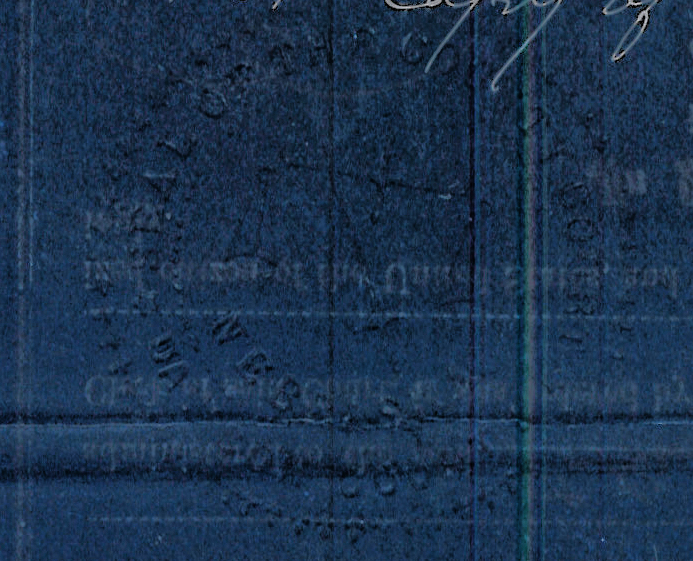
Enhancing the Seal


With the permission of the creator of the altered images, I have posted three attempts to enhance the seal on the copy of a naturalization record found in the homestead application of Focke Goldenstein in Dawson County, Nebraska.

The seal was not immediately apparent on the scan I obtained--but the document did indicate there was a seal on it and it was apparent the "seal" was not one of those drawn by hand. If it had been, I would have seen it much easier. The County Judge indicated that the certification was "given under my hand and seal." His "hand" refers to his signature.

The "seal" is in the circle which was drawn by me on the image below.


Of the three attempts, the last one (I think) makes the stamp the easiest to read.

attempt 1--not to be re-used without permission


attempt 1--not to be re-used without permission


attempt 1--not to be re-used without permission
It states "Seal of the County Court Dawson County Nebraska." The words "Seal of the County Court" run across the top of the circle and "Dawson County" is on the bottom of the circle with the word "Nebraska" above the words "Dawson County."

Careful readers will even be able to read part of the reverse side of the document.

I'm still waiting for that three-dimensional scanner.

These images were obtained from Goldenstein's homestead file

The altered images were posted with permission of the creator, who will remain anonymous, unless they wish to identify themselves. We thank them for helping us out!

Citation reminder: We are a strong believer in citing genealogical source material in the spirit of Evidence Explained. However, we choose not to include properly formatted citations in these blog posts. There's always enough information in the post to create a citation and full citations are included in my how-to newsletter Casefile Clues. 

15 April 2013

Updated On FamilySearch

This database is showing as "new or updated" on FamilySearch--I know it's been there a while, so I'm guessing it is an update:


Nebraska, Marriages, 1855-1995


Where Are My Three-Dimensional Copies

One of the drawbacks of any image reproduction is that there may be details that simply do not come across. Two dimensional copies are just that, two dimensional.

Sometimes those bumps contain clues as well.

Do you see the raised seal on this image scan?


Maybe we need a three dimensional copier.

A "Copy" of An Illinois Naturalization Made in a Nebraska Court

This is the fourth set of copies I have from the homestead file of Focke and Anna Goldenstein in Dawson County, Nebraska. Hopefully it is the last set I ever get. 

I have:
  • Paper copies made by my great-aunt in the 1970s when her husband was researching his genealogy to join the Sons of the American Revolution (my great-aunt went with him and looked up a few things on her own family).
  • Paper copies I obtained myself in the early 1990s because I was unaware of the earlier set of copies made by my great-aunt.
  • Digital copies from Fold3.com,
  • This set of color images. 
In a post later this week, we will compare these images with those from Fold3.com. Fold3.com does not have color images and (as of this writing) the only names in the index are to the actual applicant who completed the homestead process But this record has got me thinking of questions for which I do not have answers.

There are three images shown in this post. The larger image is the entire front of the document. The two smaller images are what appears on the back of this one-page document.


Naturalization record of Focke J. Goldenstein, obtained in his homestead application file


Goldenstein had to prove his citizenship before his homestead application could be approved. This document apparently has the actual seal of the Dawson County, Nebraska Court on it.

The document appears to have been one printed on blank forms for use in Illinois. However, if Goldenstein had obtained this copy in Illinois, it should have had the actual seal from Knox County, Illinois, on it--instead of the word "Seal" written on it. In other homestead files where the applicant was a naturalized citizen, I've seen the actual naturalization papers or a certified handwritten copy made by a local official where the homestead application was being completed. Those copies are usually certified transcriptions where it is clear that the entire thing was handwritten from a copy the applicant had. This document does not quite appear to be a copy like that. It would be odd for the Nebraska court official to have blank forms for Illinois on hand.

We will have more on this document in later posts. We've not even touched the following issues:

  • Why was Goldenstein's age at immigration important?
  • Why did he naturalize in Knox County, Illinois?
  • Who were his witnesses?
All of those questions have implications for the genealogist--and, for the most part, I know the answers to those questions. It is just the nature of this "copy" of Goldenstein's naturalization that has caused a few questions to arise in my mind. 

And, here's our citation:


Citation reminder: We are a strong believer in citing genealogical source material in the spirit of Evidence Explained. However, we choose not to include properly formatted citations in these blog posts. There's always enough information in the post to create a citation and full citations are included in my how-to newsletter Casefile Clues. 

14 April 2013

4 Fundamental Webinars Released


These presentations are short--approximately 20 minutes in length. The intent is to cover a narrow topic quickly for those who benefit best from presentations that are not an hour long. Presentations are clear and to the point--handouts included.
If you pre-reordered these, you should have received links for download. Please email me at mjnrootdig@gmail.com if you have not. There are two more in this series that are scheduled for release early this week. 

13 April 2013

It Is Not Enough To Say "No"

I have always believed that it was not enough in any type of summary about an ancestor to simply make a statement like, they were "not located in the 1870 census" or they were not located "in Civil War pension records." I realize that there are professional genealogists who think that the research process does not need to be included in the research report. I think it does matter. Readers of the report need to know on what basis the "couldn't find him" statement was made and it is impossible to do that unless the report includes what records were accessed and how those records were searched. Knowing that is more than just about evaluating the research--it also helps to evaluate the researcher.

Do I need to tell readers of the report that I accessed the index at 3:00 a.m. while in my sleep attire? No But I do need to tell readers that I believe George Trautvetter did not receive a Civil War pension because I looked in the following places in the following ways:

  • Pension Payment Card Index--searched the digital version of the cards at www.familysearch.org for name variants as listed in name variant list.
  • Unit Index to Pensions--searched the digital version of the cards at www.fold3.com for name variants as indicated in name variant list.
  • Name variant list--here I would list all the variants of Trautvetter that I search for in indexes of this type.
If these were part of an actual research report, I would include the actual titles of the finding aids and would flesh out the website information more than I have here. The name variant list would include spelling variants of the name that I use when searching any finding aid, whether in print or digital format.

It is not long and it is not difficult to write. But it sure beats simply saying "didn't find it" in a research report on George Trautvetter. It is imperative that we include complete accurate citations when material is located--that's done to assist the reader of the report in analyzing the search process. 

But is also imperative, in my opinion, that we include details of our search process when there is "no" result. 

New or Updated on FamilySearch

New or updated on FamilySearch since our last update:


12 April 2013

Half of Webinar Sales Donated To Cyndislist

I've known Cyndi Howells of Cyndislist fame for over fifteen years--back when she was one page. She's recently had a variety of expenses associated with her site recently, so I've decided to help her out.

Half of all webinar purchases made after you visit this page go directly to Cyndislist to help with upgrade fees and various other expenses. There is never a charge to use Cyndislist. You can even type in coupon code "cyndislist" to get $2.50 off your order.

But don't wait, this offer ends on 15 April  2013

New On FamilySearch-Alabama Estate Files

New on FamilySearch since our last update:

Alabama, Estate Files, 1830-1976


11 April 2013

Local Names of Illinois Military Organizations During the Civil War

Do you have an ancestor in an Illinois Civil War unit with a "non-standard" name. This list of "local names of military organization" for Illinois units appeared in Volume 1 of the Illinois Adjutant General's Report, published in 1900.

The window below should take you to the section of the book on GoogleBooks.

Is That Ernie?


Transcription is a thankless task and difficult to do.

But one need to keep the time period in mind. Ancestry.com's index lists this name underlined in red as "Ernie Trautvetter." I'm thankful they read the last name as "Trautvetter."

But Ernie as the first name? While I've done no studies, Ernie as a first name in 1864 would be highly suspect, especially for someone born in 1824.

It appears this name should be transcribed as "Emil," which is the correction I submitted.

Another time where ignoring first names while searching is a good idea.

And why when transcribing information it is always good to think about the plausibility of the name being what you think it is. Sometimes getting a "feel" for those old names comes only with practice.

Citation reminder: We are a strong believer in citing genealogical source material in the spirit of Evidence Explained. However, we choose not to include properly formatted citations in these blog posts. There's always enough information in the post to create a citation and full citations are included in my how-to newsletter Casefile Clues. 

Update on ELCA Records at Archives.com

My earlier email to the ELCA (Evangelical Lutheran Church in America) archivist did elicit a response and he indicated similar concerns to the ones that I had and also indicated he had expressed those concerns to Archives.com.

I'm still waiting for a response from Archives.com.

These are wonderful records, but the way they have been made available digitally does a disservice to those of us who would like to use them effectively in our research. At this point, I'm almost hesitant to blog about my findings in these records.

Color me not overly happy.


New On FamilySearch

New on FamilySearch since our last update:

10 April 2013

New Free Sample of Casefile Clues

If it's been a while since you've taken a look at my how-to newsletter, Casefile Clues, we've put a new sample up for download. Simply hit "checkout with PayPal," you'll be prompted for an email to send you the link (you can make up a name if you wish--I'll never know), but you will not be asked for a credit card or other information of that type.