Showing posts with label copyright. Show all posts

07 April 2014

Ole Man Jones, Mushroom Huntin', Chianina Cattle, and Copyight in the Dirt

[This post about old farming practices somehow turned into one on copyright.]

Some days I think I learned everything I need to know about copyright on the farm.

Jones' Old Style Farm Techniques


As a kid, I never understood the way old man Jones* farmed south of town. His corn was never as green as that of his neighbors, it was always full of weeds, and the rows didn't even look really straight. When I asked Dad what was wrong, he said Jones was farming the way they did forty years ago and probably wasn't going to change. However, it was Jones' property and it was his to do with as he saw fit. The neighbors probably thought they could have "gotten more good out of that farm," and that Jones probably wasn't making any money off the land, but that didn't matter.

The neighbors had no right to it--even if they could utilize it in a better way. The amount of money he made was not the point. Jones paid his taxes and that was all that mattered.

Copyright works the same way--it's not about whether the writer is making money off the material he writes. The writer of the material can use it as they see fit--just like Jones did his farm.

Mushroom Huntin'


We'd occasionally go mushroom hunting when I was a kid. I never really liked morels, but that didn't matter, we went hunting for them anyway. I was always well-aware of the property line on west pasture, the back forty, and any other timber we had. Farm kids always know where the property line is--it was ingrained from childhood and from time spent fixing fence. And...no matter how many mushrooms you might see on the other side of the fence on the neighbor's property, you kept your rear on your own place. We weren't to go trespassing on the neighbor's property and we weren't to take anything off the neighbor's property--not even mushrooms they were just going to let die and would never notice.** We didn't want anyone trespassing on our place and we afforded others the same respect.

Copyright works the same way. You don't take what is not yours and tell others that it is. Of course you can use small amounts under "fair use," but you can't use larger amounts of someone else's material. I never thought to take just one mushroom under "fair use."

Chianina Cattle


Of course, the neighbor can't copyright ideas or facts. If  he starts raising Chianina cattle and appears to be turning a profit, there's nothing to stop me from raising my own.

What Does This Have to Do With Copyright?


Of course, I cannot copyright specific facts about my ancestor, just like my neighbor can't stop me from raising Chianina cattle. But I do have copyright to creative material I write about my ancestor and I have a right to that material whether I make money from it or not, just like old man Jones was entitled to farm in a manner less productive than his neighbors. I also have the right not to have others steal my material, just like I wasn't supposed to take mushrooms off the neighbor's land.

The details of copyright may be a a little murky, but the essence of it--it's all right there, plain as dirt.

* name changed
** we were only allowed to go on the neighbor's property if one of the cows got out onto the neighbor's property and as soon as she was back in, you could be certain we'd be fixin' fence.

11 February 2013

The Actual Cat & Mouse Quilt

An earlier blog post discussed a quilt made by Sophia (Weber) Haase that is housed in the Great Lakes Quilt Center at the University of Michigan.

The image of the quilt, like any image, can't just be used in whatever fashion I want. I can use it in my personal collection and in my own private research. But the public use of images that I did not create needs to recognize the rights of the original creator of those images and, in this case, the repository holding the quilt that was photographed. It is not enough just to indicate where the original was located--if I'm going to "publish" a picture I did not take that is not in the public domain, I need permission. I emailed the Center and received permission to use the image in a blog post.

So, with permission, here's an image of the quilt.


"Variation of Cats and Mice with Sawtooth Border," made by Sophia  (Weber)  Haase, late 19th century, in the collection of The State University of Michigan Museum; digital image, The Quilt Index, (http://www.quiltindex.org/fulldisplay.php?kid=1E-3D-558), obtained 11 February 2013. Image used with permission of the Great Lake Quit Center
I'm not a quilter, nor am I an artist, so the "cats and mouse" is lost on me. I can see the sawtooth border though.

It's a wonderful item to stumble across. And it makes the point that family items can easily be housed in unexpected places a distance from where the family or creator of the item actually lived. Sophia spent much of her life near Niota, Illinois--her daughter actually donated the quilt. And, as we've been stressing, it's important to obtain permission from the creators of photographs and the holders of archival material before publishing them--even in a blog post. Copyright matters.

--------------------
For those who stumble on to this page, Sophia (Weber) Haase was the wife of Herman Haase. He was a brother to Franciska (Bieger) Trautvetter (1851-1888) my great-great-grandmother.
-------------------

21 December 2012

Why No Index and Why You Can "Well Afford to Read the Book"

Orville Merton Kile said in 1958 what many genealogists would love to say today when he explained why his book lacked an index:

"Those who use the book as a part of the research for ancestors can well afford the relatively few hours necessary to read the entire book and gain a general picture of the family history and thus perhaps discover where they fit in. That would scarcely seem to be too much to ask as against the research of the writer extending over a ten year period..."

That quote and the image that follows come from page 171 of his "A Partial History of the Kyle, Kile, Coyle Family In America: With Some Scotch, Irish, And English Background."
Kile, Orville Merton, 1886-. A Partial History of the Kyle, Kile, Coyle Family In America: With Some Scotch, Irish, And English Background. Baltimore: Print. by Waverly Press, 1958.


For a discussion of how I can "get by" using this image and quote, see our earlier blog post, "Can I Use the 1958 Kile Genealogy and Unbecoming Genealogical Conduct."

Can I Use the 1958 Kile Genealogy and Unbecoming Genealogical Conduct


I love old genealogies--warts and all. 

While any compilation can contain errors, material written fifty or even one hundred years in the past can contain information not available elsewhere. The authors of these materials may have had access to individuals who are now deceased, original records that are no longer extant, and tombstones that have weathered beyond readability. A search of Hathitrust.org located a 1958 book on a family that I am researching.

In the case of this book, there were some images I wanted to use myself and perhaps publish them on my blog or in more traditional print media. However, I simply cannot just use material from a previously published book. One problem with these print materials is "how much and what can I use?" fairly. Another question is "is the material under copyright?" These questions are tied--with copyright dictating.

What Can I Use?

I'm pretty judicious in using someone else's material whether it is still under copyright or not.  I use one sentence and at most two--even if the copyright has expired. And I cite and give credit to the author--copyrighted material or not. All the time. No matter what. One or two sentences are small enough that "fair use" is likely to apply to those items that are still under copyright. If the item is not under copyright, I could use larger portions of it--still using citations because that's simply the aboveboard way to do things. If I wanted to quote a longer passage of material still in copyright, I would ask first

Because I usually like to put my own spin on things, I rarely need more than two sentences of someone else's work. It's the way I operate with my writing, is more ethical, and keeps me generating my own content. It also reduces the chance I get called on the carpet for using someone's material.

Is It Copyrighted?

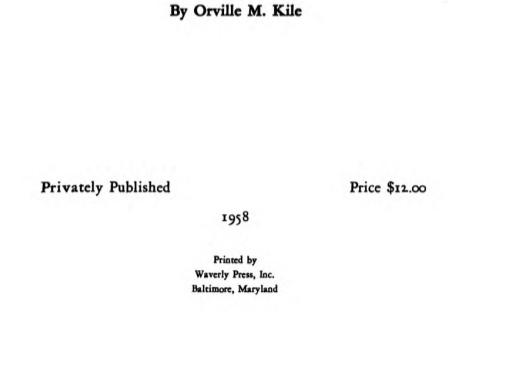
I wanted to use some images from the 1958 genealogy and a really neat page from the back of the book--more than I have ever used from a book before. I would need permission from the author if the material was still under copyright. I used the copyright chart that appeared in a post on  Judy G. Russell's The Legal Genealogist ("Copyright and the Old Family Photo") as a guide to determining if the book I discovered was subject to copyright or not.  The book indicated it was privately published in 1958. Privately published is still published.  There was no copyright notice included in the book. Using the chart, I determined that the book in the public domain based upon the lack of a copyright notice and the year of publication.

Judy G. Russell of The Legal Genealogist and I had a brief email discussion about a book I had located in digital form. It never hurts to ask, but the chart and the book itself seemed to indicate my use would be ok.

Judy's response to my email on 20 December 2012, read in part:

"It has a very easy answer: anything published between 1923 and 1977 had to have a copyright notice. If it didn't include a copyright notice, then it didn't meet the formalities required for copyright protection and it would have gone into the public domain immediately on publication and would still be in the public domain today."

The fact that this book was immediately in the public domain had not dawned on me until I read Judy's email. 

Hathitrust also indicated that the book was in the public domain. It was good that they agreed with me, but just because they agreed with me does not mean that both of us have to be right. 

The Book?

Kile, Orville Merton, 1886-. A Partial History of the Kyle, Kile, Coyle Family In America: With Some Scotch, Irish, And English Background. Baltimore: Print. by Waverly Press, 1958.


That citation was the one generated by Hathitrust.org. The generation of citations is nice feature of the site even if the citations are not necessarily in Evidence Explained format. It contains all necessary details and, when necessary, I can tweak the citation.

The Title Page
The year of publication is given and there is no copyright notice. So, as noted earlier, I am in the clear to use material from this publication.

We'll be seeing an item or two from this book in future blog posts. I'll always cite anything taken from this book. To use, even out-of-copyright material without citation, is conduct unbecoming a genealogist.

And using copyrighted material without permission is even worse. 

20 December 2012

Don't Steal My Stuff

Note: I'm not a lawyer and I don't play one on the Internet. Seek legal counsel if you have serious copyright issues you wish to pursue legally--but remember--it ain't cheap.

I realize that they are "your" ancestors and you probably have some emotional attachment to them. That's perfectly normal.

You may also have some emotional attachment to facts that have taken you a long time, some money, and a great deal of time to ascertain. Let's say that you "discover" that Johann Schmitpluffer was born on 12 August 1739 in Gottareallylongschmirkingname, Germany, the son of Erasmus and Anna (Umlautholder) Schmitpluffer.

You decide put those facts online, perhaps including your analysis along with those facts. It is a very long and detailed analysis, reflecting your research and your own creative way of writing up the analysis. Creative here meaning that your prose is eloquent, engaging and keeps the reader on the edge of her seat. We do not  mean "creative" in the sense that you made it all up.

Your distant cousin from Bangor decides to use the fact that Johann Schmitpluffer was born on 12 August 1739 in Gottareallyloneschmirkingname, Germany, the son of Erasmus and Anna (Umlautholder) Schmitpluffer in his genealogy database, his blog etc.

Oh, your "taters are irked." You fly off a nasty email--it is not eloquent and it is not engaging. He has used "your" information and he needs to pull it.

Sorry, it's not your information. It is a fact and you have no more right to use that fact than anyone else.

Your distant cousin from Seattle decides to copy all your eloquent, engaging prose and use it in its entirety in her own material. The Seattle relative does not give you one whit of credit. That's a problem and that's a violation of your copyright because your paragraphs of writing were used. Whether you can get the Seattle resident to remove their material or cease from using it is another story. You can try and convince them nicely to remove the paragraphs of your writing, but they may choose not to. Enforcing your copyright may not be easy and if you decide to hire lawyers it certainly isn't cheap. You may contact the ISP or the web host that houses the information and prove that the prose is yours. You may get lucky and they may remove it.

And if your cousin in Seattle removes the prose and replaces it with:

Johann Schmitpluffer was born on 12 August 1739 in Gottareallyloneschmirkingname, Germany, the son of Erasmus and Anna (Umlautholder) Schmitpluffer

There's not a lot you can do.


10 December 2012

Imitation is Not All that Flattering--and Some Cold Realities

Plagiarism has been on my mind quite a bit lately. Before you read the rest of this post be advised I am not, repeat not, a lawyer of any persuasion. Also be advised that this post contains opinion and if you'd rather not read my thoughts on copyright, stealing content, and creating your own content, then move on.

This post is not about copyright law and about what is legal and what is not.It's not about what constitutes fair use. Those are important topics, but I'm not a lawyer and I don't play one on the Internet. Plagiarism, and the blatant passing off as your own something that is not, irritates most writers and content creators. Their frustration with these "copiers" has little to do with the law even though it is designed to protect them.  It has to do with what is right and with what is just. Copying someone else's stuff is cheating pure and simple.

There are laws to protect the copyright of content creators. The problem is that it is not easy nor is it cheap to enforce legally enforce copyright and to obtain a judgement against violators. Even if you are clearly in the right. Content thieves are not all stupid. Content thieves are lazy, but laziness does not equal stupidity. They are smart enough to figure out how to steal content and lazy enough to not create their own.

Content thieves play off fear, ignorance, and a stark financial reality. The majority of individuals generating genealogical content on blogs and in other media are not well-heeled. They do not have intellectual property attorneys on staff that they can simply sic on the violators. Hiring an attorney to write a "cease and desist letter" on letterhead is not cheap. Court is worse. Enforcing copyright in a court of law takes serious money that writers generally use to support their business and their families. Some bloggers and writers only do so "for fun," making the expense of legal fees even more of a problem. Enforcing copyright takes time away from generating income for those who use their content to support themselves. Content thieves know this. Fighting these battles takes time away from the "for fun" bloggers and may even make some of them stop blogging entirely. And that's a loss to those who use the work of these content creators in an honest and ethical fashion.

The content thieves feed on a forced inertia on the part of many content creators. They also rely on the fact that most content creators never discover the use of their material.

Avoiding the Problem


The typical genealogist who wants to avoid problems when using someone's "information" should simply ask if  they can use it. Most of us don't mind as long as we are quoted verbatim and in context. Of course, facts cannot be copyrighted, but we're not talking about simple facts here. We are talking about using someone else's sentences or paragraphs and passing them off as your own, without credit. Using a few sentences, including a citation to the original, usually is not a problem. Copying even a sentence that is not yours and using it verbatim may not exactly put you at a major risk, but it makes you look like you can't create your own stuff. Play with the big girls and boys and create your own content.

Create Your Own Content


If you see a sentence such as "James and Elizabeth Rampley moved to Illinois in 1847, settling first in Adams County, Illinois, and then moving to Walker Township two years later," don't just copy that into a report or blog post of your own without citing it. You didn't write this mundane piece of commentary, so do not pass it off as your own. If you think the sentence is the  epitome of eloquent prose, quote it and cite it. The sentence could easily be rephrased in several more effective ways:

  • "In 1847, while in their early forties with several teen aged children in tow, James and Elizabeth Rampley left their home in Coshocton County, Ohio, and settled in Adams County, Illinois. By 1849, the Rampleys had moved the short distance north to Hancock County's Walker Township, where James established his own cooperage in addition to operating a farm."
  • In 1847, sick of Ohio and desiring to leave their relatives behind, the Rampleys moved west to Adams County, Illinois. In 1849, sick of Adams County, Illinois, and the few relatives who had moved there with them, the Rampleys moved to Walker Township. This is where they stayed because Elizabeth told James if he got sick of any more places or any more relatives, he could get sick of her as well and leave her behind.
Maybe the second example is not quite the best (unless Elizabeth's diary confesses such things to the reader). Using a variety of records and sources and a little common sense, you could have sentence or two that reflects your unique style more than the original sentence that was copied. And you haven't violated anyone's copyright. And you've generated your own unique content.

The same is true of images on the Internet. If you did not take the picture, it is not yours to use as you will. Period. It does not matter if it is your great-grandmother's tombstone which your great-great-grandfather carved himself. You did not take the picture. The taker of the photograph may not care if you use the photograph, but contact them and ask first.

Didn't Make It-Ask


It's really pretty simple--if you did not create it, ask to use it. Don't use it if the person tells you "no." The creator has the right to tell you "no" that you cannot use their material. Most will allow it. Perhaps your parents used the same word once upon a time (or maybe they should have). When told "no," put on the big-boy pants and move on. Research the people and the places yourself and create your own content. You may discover something the original author didn't know or write better prose. Don't want to spend all that time doing research? Then get a different past time because that's what genealogy is--research.

Some genealogists have an emotional attachment to the ancestors that they write about--when you steal the words they wrote about their great-grandmother it bothers them more than if they were simply reporting on the weather or the national deficit. Although writing about the deficit may make them cry for different reasons.

It's on the Internet-I Can Use It


And the argument that "it's on the Internet, I can use it no matter what" does not hold water. Using what you did not make is not correct. It is as simple as that. That "it's online, I can use it" argument is a sieve through which all water passes.

Some content creators use income from their writings and blogs to support themselves and their families, augment their income, or support their genealogy habit. For some the loss of income makes it difficult for them to do that. The "loss of income" is one reason why copyright was created. But many do not generate the sort of revenue required to take the legal action to protect their copyright. Copyright also exists so that people can exercise control over the use of their creative material and even choose to not have others use it.

If you didn't create it--don't use it so that others think you did.

We'll be posting a future update on what you can do when your copyright has been violated, without necessarily breaking the bank. There are no guarantees, but most "violaters" are using a hosting service, a "cloud," or some company to host their content. Often that host does not want to be known to host copyrighted material.

I'm done---time to create some original content. There are very few people I would steal from, and unfortunately, they would know that I did it and know how to "deal with me appropriately," so I'm stuck creating my own!


03 July 2007

Can I Copyright Katharine Wickiser's Maiden Name?

Discovering Katharine Wickiser's maiden name today was a great find for me. Once you've been researching for a while new names are not located as frequently as they were in the early days of research.

Now...do I expect everyone to credit me with finding this? No. Would it be nice, yes. However, I realize that this information will appear in GEDCOM files and other online sites in the near future and I won't be credited with locating the information.

Can I copyright the maiden name of Katharine Wickiser? Especially if I discovered it? The answer is no.

Katharine's maiden name is a fact. Even if it took me twenty years and twenty thousand dollars to find it (which it did not), the name still remains a fact. Facts are not copyrightable. Otherwise, I'd simply copyright 2+2 = 4 and charge banks for each time they used that fact when computing balances.

If I write a paragraph on her maiden name that paragraph is copyrightable. If I write a blog entry on how I cannot copyright her maiden name, that blog entry is copyrightable. But the name itself: no.

And the word is copyright. Not copywrite. If you write your copy right, you can copyright that copy. But even if you copy the fact right, you cannot copyright the fact. Even if you copy something wrong, you can copyright that. Why you would want to copyright something that was not copied right is beyond me, but who knows?

Those who wish to learn more about how copyright applies to genealogists can do so here.